PRODUCT STRATEGY
What is a Product?
A product is anything that can be offered to a market for attention, acquisition, use, or consumption that might satisfy a want or need. It includes physical objects, services, places, organizations, and ideas.
There are THREE levels of products:
Core Product: the most basic level of a product – what the customer is actually buying
The Actual product is a combination of the tangible and intangible attributes that deliver the core benefit. It includes:
- Facilitating Products that must be present for the guest to use the core product and/or Supporting Products to add value to the core product. For example, automobiles have combinations of attributes such as horsepower and fuel economy, which determine its acceleration and cost of ownership (gas mileage, etc). The brand name is also a part of the actual product.
Augmented Products: Elements such as accessibility, atmosphere, customer interaction with the service organization, customer participation, or customers’ interaction with each other combine with the core, facilitating and supporting products to provide the augmented product. For tangible product like automobiles, this could be an extended warranty, financing, among other benefits.
Considerations for Augmented Products
Accessibility
If a product is not accessible it has no value
Two barriers to accessibility are hours of operation and lack of knowledge
Products must be accessible when the guest wants to use them
Atmosphere: The Physical Environment
Atmosphere is a critical element in services
It can be the customer’s reason for choosing to do business with an establishment
Atmosphere is appreciated through the senses. Sensory terms provide descriptions for the atmosphere of a particular set of surroundings
Customer Participation
The customer participates in the delivery of most hospitality and travel products
There are three phases to this involvement: joining, consumption, and detachment
Customer Interaction
An area that is drawing the interest of hospitality researchers is the interaction of customers with each other
Hospitality organizations must manage the interaction of customers to ensure that some do not negatively affect the experience of others
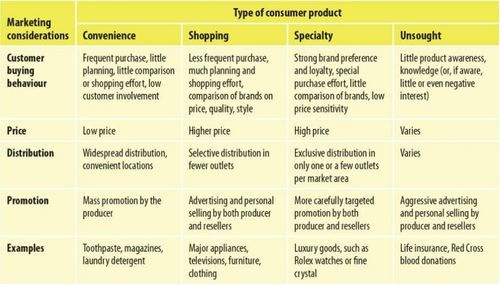
TYPES OF CONSUMER PRODUCTS
Use Brands and Identify the Major Branding Decisions
Brand is a name, term, sign, symbol, design, or a combination of these elements that is intended to identify the goods or services of a seller and differentiate them from those of competitors.
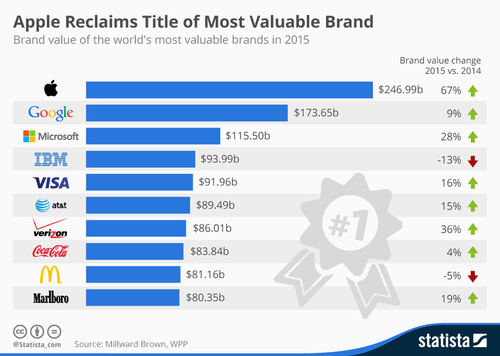
Source: https://www.statista.com/chart/3502/most-valuable-brands-2015/
The role of brands. Brands identify the source or maker of a product and allow consumers to assign responsibility for its performance to a particular company.
The scope of branding. Branding is endowing products and services with the power of a brand. It’s all about creating differences between products. Marketers need to teach consumers “who” the product is—by giving it a name and other brand elements to identify it—as well as what the product does and why consumers should care. Branding creates mental structures that help consumers organize their knowledge about products and services in a way that clarifies their decision-making and, in the process, provides value to the firm.
Brand equity is the added value endowed on products and services. It may be reflected in the way consumers think, feel, and act with respect to the brand, as well as in the prices, market share, and profitability the brand commands for the firm.
Brand Portfolios. The brand portfolio is the set of all brands and brand particular category or market segment. The hallmark of an optimal brand portfolio is the ability of each brand in it to maximize the equity in combination with all the other brands in it. Marketers carefully monitor brand portfolios over time to identify weak brands and kill unprofitable ones.
Brand identify: the meaning, position and goals projected by the organisation
Brand image: reflect the perceptions and associations with a brand, which are held in consumer memory.
Brand association: the attributes that people assign to your brand, either because they have been told to think that, or have formed their opinion. Association can be rated on strength, favourability, and uniqueness. Association maps can show the relative importance and strength of each attribute in the minds of consumers.
Brand awareness: the extent to which a brand is recognized by potential customers and correctly associates with its products.
Brand loyalty is typically defined by the number of repeated purchases.
NEW PRODUCT DEVELOPMENT (NPD)
To create successful new products, a company must understand its consumers, markets, and competitors and develop products that deliver superior value to customers. It must carry out strong new-product planning and set up a systematic, customer-driven new-product development process for finding and growing new products
Idea Generation: New-product development starts with idea generation—the systematic search for new-product ideas. The purpose of idea generation is to create a large number of ideas
Idea Screening: The purpose of screening is to spot good ideas and drop poor ones as quickly as possible. Product development costs rise greatly in later stages, so the company wants to proceed only with ideas that will turn into profitable products. The idea or concept screening stage is the appropriate time to review carefully the question of product line compatibility.
Concept Development and Testing: Surviving ideas must now be developed into product concepts. It is important to distinguish between a product idea, a product concept, and a product image. A product idea envisions a possible product that company managers might offer to the market. A product concept is a detailed version of the idea stated in meaningful consumer terms. A product image is a way that consumers picture an actual or potential product. Some NPD processes include marketing strategy development.
Marketing Strategy & Business Analysis: The next step is marketing strategy development: designing an initial marketing strategy for introducing the product into the market. The marketing strategy statement consists of three parts. The first part describes the target market, the planned product positioning, and the sales, market share, and profit goals for the first few years. The second part of the marketing strategy statement outlines the product’s planned price, distribution, and marketing budget for the first year. The third part of the marketing strategy statement describes the planned long-run sales, profit goals, and marketing mix strategy. Business analysis involves a review of the sales, costs, and profit projections to determine whether they satisfy the company’s objectives
Product Development & Test Marketing: If the product concept passes the business test, it moves into product development and into a prototype. One problem with developing a prototype is that the prototype is often limited to the core product. Many of the intangible aspects of the product, such as the performance of the employees, cannot be included. Some NPD processes classified this stage as Test Marketing. Test Marketing: The product and marketing program are introduced into realistic market settings. Market testing allows the marketer to gain experience in marketing the product, to find potential problems, and to learn where more information is needed before the company goes to the great expense of full introduction
Commercialization: The product is brought into the marketplace. If the company goes ahead with commercialization, it will face high costs.
Additional Reference: https://www.netsolutions.com/insights/everything-about-new-product-development/
PRODUCT LIFE CYCLE (PLC)
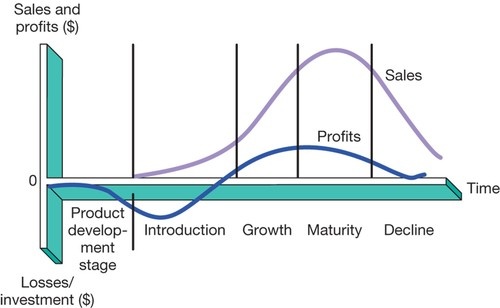
Strategy changes are often the result of changing market and environmental conditions as the product moves through the product life cycle (PLC)
Product development
Begins when the company finds and develops a new product idea
During product development, sales are zero and the company’s investment costs add up
Introduction
A period of slow sales growth as the product is being introduced into the market
Profits are nonexistent at this stage because of the heavy expenses of the product introduction
Growth
A period of rapid market acceptance and increasing profits
Maturity
A period of slowdown in sales growth because the product has achieved acceptance by most of its potential buyers
Although sales are still high, profits level off or decline because of increased marketing outlays to defend the product against the competition
Decline
The period when sales fall off quickly and profits drop
Example of PLC Application for a Hotel
In the introductory stage, the owners or managers of the hotel will probably need to spend money to increase the public’s awareness of the hotel. Many hotels decide to have a soft opening in order to “work the bugs out”. The hotel will generally lose money during this stage.
In the growth stage, occupancy and sometimes Average Daily Rate (ADR) are increasing rapidly. The benefits of advertisements and other forms of promotion are being felt.
In the maturity stage, more competitors have entered the market and sales are flat, although still robust. It is important to keep the hotel in good repair and to update any necessary design elements or technologies to keep the hotel in this stage.
In the decline stage, occupancy levels drop. The property is considered old and out of date, or the location is no longer desirable. A company can keep its products from reaching the decline stage by targeting new markets, using careful pricing strategies, decreasing the number of product lines, and changing or increasing its distribution channels.

 Lesson: