Showing posts with label management. Show all posts

Tuesday, December 23, 2025

Marketing Series: Product Strategy

 PRODUCT STRATEGY

What is a Product?

A product is anything that can be offered to a market for attention, acquisition, use, or consumption that might satisfy a want or need. It includes physical objects, services, places, organizations, and ideas. 

There are THREE levels of products:

  • Core Product: the most basic level of a product – what the customer is actually buying 

  • The Actual product is a combination of the tangible and intangible attributes that deliver the core benefit. It includes:

    Facilitating Products that must be present for the guest to use the core product and/or Supporting Products to add value to the core product. For example, automobiles have combinations of attributes such as horsepower and fuel economy, which determine its acceleration and cost of ownership (gas mileage, etc). The brand name is also a part of the actual product.

  • Augmented Products: Elements such as accessibility, atmosphere, customer interaction with the service organization, customer participation, or customers’ interaction with each other combine with the core, facilitating and supporting products to provide the augmented product. For tangible product like automobiles, this could be an extended warranty, financing, among other benefits.


Considerations for Augmented Products

Accessibility

  • If a product is not accessible it has no value

  • Two barriers to accessibility are hours of operation and lack of knowledge

  • Products must be accessible when the guest wants to use them

Atmosphere: The Physical Environment

  • Atmosphere is a critical element in services

  • It can be the customer’s reason for choosing to do business with an establishment

  • Atmosphere is appreciated through the senses. Sensory terms provide descriptions for the atmosphere of a particular set of surroundings

Customer Participation

  • The customer participates in the delivery of most hospitality and travel products

  • There are three phases to this involvement: joining, consumption, and detachment

Customer Interaction

  • An area that is drawing the interest of hospitality researchers is the interaction of customers with each other

  • Hospitality organizations must manage the interaction of customers to ensure that some do not negatively affect the experience of others


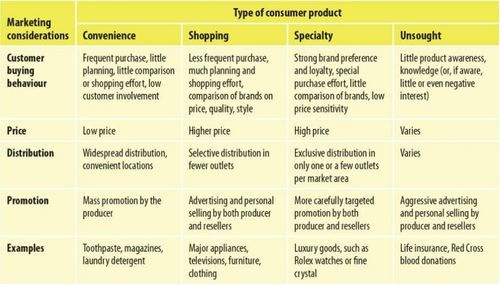
TYPES OF CONSUMER PRODUCTS

Types of product


Use Brands and Identify the Major Branding Decisions

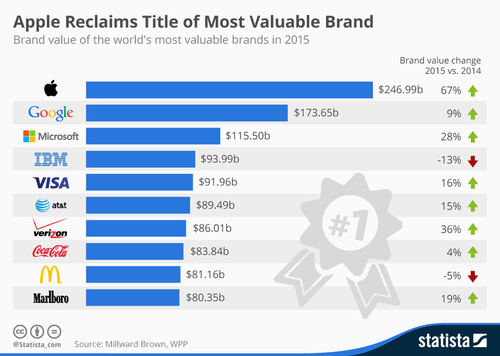
Brand is a name, term, sign, symbol, design, or a combination of these elements that is intended to identify the goods or services of a seller and differentiate them from those of competitors. 

chartoftheday_3502_most_valuable_brands_2015_n

Source: https://www.statista.com/chart/3502/most-valuable-brands-2015/ 


  • The role of brands. Brands identify the source or maker of a product and allow consumers to assign responsibility for its performance to a particular company. 

  • The scope of branding. Branding is endowing products and services with the power of a brand. It’s all about creating differences between products. Marketers need to teach consumers “who” the product is—by giving it a name and other brand elements to identify it—as well as what the product does and why consumers should care. Branding creates mental structures that help consumers organize their knowledge about products and services in a way that clarifies their decision-making and, in the process, provides value to the firm. 

  • Brand equity is the added value endowed on products and services. It may be reflected in the way consumers think, feel, and act with respect to the brand, as well as in the prices, market share, and profitability the brand commands for the firm. 

  • Brand Portfolios. The brand portfolio is the set of all brands and brand particular category or market segment. The hallmark of an optimal brand portfolio is the ability of each brand in it to maximize the equity in combination with all the other brands in it. Marketers carefully monitor brand portfolios over time to identify weak brands and kill unprofitable ones.

  • Brand identify: the meaning, position and goals projected by the organisation

  • Brand image: reflect the perceptions and associations with a brand, which are held in consumer memory. 

  • Brand association: the attributes that people assign to your brand, either because they have been told to think that, or have formed their opinion. Association can be rated on strength, favourability, and uniqueness. Association maps can show the relative importance and strength of each attribute in the minds of consumers. 

  • Brand awareness: the extent to which a brand is recognized by potential customers and correctly associates with its products.

  • Brand loyalty is typically defined by the number of repeated purchases.


NEW PRODUCT DEVELOPMENT (NPD)

To create successful new products, a company must understand its consumers, markets, and competitors and develop products that deliver superior value to customers. It must carry out strong new-product planning and set up a systematic, customer-driven new-product development process for finding and growing new products 

  1. Idea Generation: New-product development starts with idea generation—the systematic search for new-product ideas. The purpose of idea generation is to create a large number of ideas 

  2. Idea Screening: The purpose of screening is to spot good ideas and drop poor ones as quickly as possible. Product development costs rise greatly in later stages, so the company wants to proceed only with ideas that will turn into profitable products. The idea or concept screening stage is the appropriate time to review carefully the question of product line compatibility.

  3. Concept Development and Testing: Surviving ideas must now be developed into product concepts. It is important to distinguish between a product idea, a product concept, and a product image. A product idea envisions a possible product that company managers might offer to the market. A product concept is a detailed version of the idea stated in meaningful consumer terms. A product image is a way that consumers picture an actual or potential product. Some NPD processes include marketing strategy development.

  4. Marketing Strategy & Business Analysis: The next step is marketing strategy development: designing an initial marketing strategy for introducing the product into the market. The marketing strategy statement consists of three parts. The first part describes the target market, the planned product positioning, and the sales, market share, and profit goals for the first few years. The second part of the marketing strategy statement outlines the product’s planned price, distribution, and marketing budget for the first year. The third part of the marketing strategy statement describes the planned long-run sales, profit goals, and marketing mix strategy. Business analysis involves a review of the sales, costs, and profit projections to determine whether they satisfy the company’s objectives 

  5. Product Development & Test Marketing: If the product concept passes the business test, it moves into product development and into a prototype. One problem with developing a prototype is that the prototype is often limited to the core product. Many of the intangible aspects of the product, such as the performance of the employees, cannot be included. Some NPD processes classified this stage as Test Marketing. Test Marketing: The product and marketing program are introduced into realistic market settings. Market testing allows the marketer to gain experience in marketing the product, to find potential problems, and to learn where more information is needed before the company goes to the great expense of full introduction 

  6. Commercialization: The product is brought into the marketplace. If the company goes ahead with commercialization, it will face high costs.

Additional Reference: https://www.netsolutions.com/insights/everything-about-new-product-development/ 


PRODUCT LIFE CYCLE (PLC)

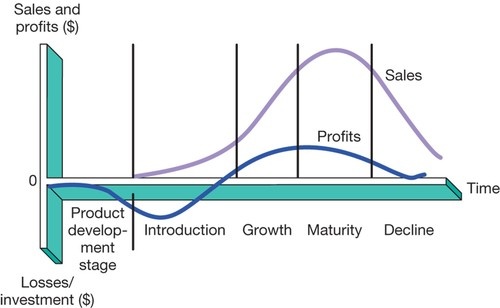
PLC

Strategy changes are often the result of changing market and environmental conditions as the product moves through the product life cycle (PLC)


Product development

  • Begins when the company finds and develops a new product idea

  • During product development, sales are zero and the company’s investment costs add up

Introduction

  • A period of slow sales growth as the product is being introduced into the market

  • Profits are nonexistent at this stage because of the heavy expenses of the product introduction

Growth

  • A period of rapid market acceptance and increasing profits

Maturity

  • A period of slowdown in sales growth because the product has achieved acceptance by most of its potential buyers

  • Although sales are still high, profits level off or decline because of increased marketing outlays to defend the product against the competition

Decline

  • The period when sales fall off quickly and profits drop


Example of PLC Application for a Hotel

  • In the introductory stage, the owners or managers of the hotel will probably need to spend money to increase the public’s awareness of the hotel. Many hotels decide to have a soft opening in order to “work the bugs out”. The hotel will generally lose money during this stage. 

  • In the growth stage, occupancy and sometimes Average Daily Rate (ADR) are increasing rapidly. The benefits of advertisements and other forms of promotion are being felt. 

  • In the maturity stage, more competitors have entered the market and sales are flat, although still robust. It is important to keep the hotel in good repair and to update any necessary design elements or technologies to keep the hotel in this stage. 

  • In the decline stage, occupancy levels drop. The property is considered old and out of date, or the location is no longer desirable. A company can keep its products from reaching the decline stage by targeting new markets, using careful pricing strategies, decreasing the number of product lines, and changing or increasing its distribution channels. 

Management Series: Charismatic and Transformational Leadership

 Charismatic and Transformational Leadership

After studying this topic, you should be able to:

  • Identify the similarities and differences between charismatic and transformational leadership.
  • Discuss how leaders, followers, and the situation affect attributions of charisma.
  • Analyse the traits, behaviors, and influence processes included in each type of leadership.
  • Explain the benefits and costs of charismatic leadership for followers and the organization.


In the 1980s, management researchers became very interested in the emotional and symbolic aspects of leadership. These processes help us to understand how leaders influence followers to make self‐sacrifices and put the needs of the mission or organization above their materialistic self‐interests. Theories of charismatic and transformational leadership describe this important aspect of leadership.

jobs

Like many great leaders, Ronald Reagan had charisma. So does Barack Obama. Thomas Watson, Alfred Sloan, Steve Jobs, and Richard Branson are good examples of charismatic leaders in the industry. Charisma is a rather elusive concept; it is easy to spot but hard to define. Charisma is a Greek word that means “divinely inspired gift,” such as the ability to perform miracles or predict future events.

Weber (1947) used the term to describe a form of influence based not on tradition or formal authority but rather on follower perceptions that the leader is endowed with exceptional qualities. According to Weber, charisma occurs during a social crisis when a leader emerges with a radical vision that offers a solution to the crisis and attracts followers who believe in the vision. The followers experience some successes that make the vision appear attainable, and they come to perceive the leader as extraordinary.

Transformational leadership in another type of theory used to describe how effective leaders inspire and transform followers by appealing to their ideals and emotions. The terms transformational and charismatic are used interchangeably by many writers, but despite the similarities there are some important distinctions. This chapter describes the major theories of charismatic and transformational leadership, compares and evaluates the theories, reviews the research findings, and provides some practical guidelines for leaders.


Attribution Theory of Charismatic Leadership

Conger and Kanungo (1987) proposed a theory of charismatic leadership based on the assumption that charisma is an attributional phenomenon. Subsequently, a refined version of the theory was presented by Conger (1989) and by Conger and Kanungo (1998). According to the theory, follower attribution of charismatic qualities to a leader is jointly determined by the leader’s behavior, expertise, and aspects of the situation.

Follower attributions of charisma depend on several types of leader behavior. These behaviors are not assumed to be present in every charismatic leader to the same extent, and their relative importance depends to some extent on the leadership situation.

Behavior of Charismatic Leaders

1. A Novel and Appealing Vision

Charisma is more likely to be attributed to leaders who advocate a vision that is highly discrepant from the status quo, but not so radical that followers will view the leader as incompetent or insane. A leader who supports the status quo or advocates only small, incremental changes will not be viewed as charismatic.

2. Emotional Appeals to Values

Followers are more likely to attribute charisma to leaders who inspire them with emotional appeals to their values and ideals. Leaders who use authority to implement an innovative strategy for attaining important objectives may gain more expert power if the strategy is successful, but unless they articulate an ideological vision to justify the strategy, they are unlikely to appear charismatic.

3. Expression of Confidence and Optimism

Leaders who appear confident about their proposals are more likely to be viewed as charismatic than leaders who appear doubtful and confused. Unless the leader communicates self‐confidence, the success of an innovative strategy may be attributed more to luck than to expertise. A leader’s confidence and enthusiasm can be contagious. Followers who believe the leader knows how to attain the shared objective will work harder, thereby increasing the actual probability of success.

4. Self-Sacrifice

Leaders are more likely to be viewed as charismatic if they make self‐sacrifices for the benefit of followers, and they take personal risks or incur high costs to achieve the vision they espouse. Trust appears to be an important component of charisma, and followers have more trust in a leader who seems less motivated by self‐interest than by concern for followers. Most impressive is a leader who actually risks substantial personal loss in terms of status, money, leadership position, or membership in the organization.

5. Unconventional Behavior and Methods

Charisma is more likely to be attributed to leaders who act in unconventional ways to achieve the vision. The leader’s methods for attaining the idealized goal must differ from conventional ways of doing things in order to impress followers that the leader is extraordinary. The use of innovative strategies that appear successful results in attribution of superior expertise to the leader by followers.

6. Demonstrate Exceptional Abilities

The charismatic leader also arouses a sense of excitement and adventure. He or she is an eloquent speaker who exhibits superior verbal skills, which help communicate the vision and motivate followers. Walt Disney mesmerized people with his storytelling; had enormous creative talent; and instilled in his organization strong values of good taste, risk-taking, and innovation.


movieLearn from Movies!

CHARISMATIC LEADERSHIP 

  1. What are the traits you can identify from Coach Boone?
  2. Do you have these traits? If yes, which traits; if no, why not?

> POST YOUR REFLECTION NOW <


Traits and Values of Charismatic Leaders

Evidence of charismatic leadership is provided by the leader-follower relationship, and a charismatic leader has profound and unusual effects on followers. Followers perceive that the leader’s beliefs are correct, they willingly obey the leader, they feel affection toward the leader, they are emotionally involved in the mission of the group or organization, they have high-performance goals, and they believe that they can contribute to the success of the mission.

Charismatic leaders are likely to have a strong need for power, high self‐confidence, and a strong conviction in their own beliefs and ideals. The leadership behaviors that explain how a charismatic leader influences the attitudes and behavior of followers include the following: 

  1. Articulating an appealing vision,
  2. Using strong, expressive forms of communication when articulating the vision
  3. Taking personal risks and making self‐sacrifices to attain the vision
  4. Communicating high expectations
  5. Expressing optimism and confidence in followers
  6. Modeling behaviors consistent with the vision,
  7. Managing follower impressions of the leader
  8. Building identification with the group or organization
  9. Empowering followers.


Consequences of Charismatic Leadership

How to differentiate between positive and negative charismatic leaders has been a problem for leadership theory. It is not always clear whether a particular leader should be classified as a positive or negative charismatic. One approach is to examine the consequences for followers. However, most charismatic leaders have both positive and negative effects on followers, and it is not always clear whether a particular outcome is beneficial or detrimental.

Effects of Positive Charismatics

  • The positive charismatic leader usually creates an “achievement‐oriented” culture, a “high‐performing system”, or a “hands‐on, value‐driven” organization. The organization has a clearly understood mission that embodies social values beyond mere profit or growth, members at all levels are empowered to make important decisions about how to implement strategies and do their work, communication is open and information shared, and organization structures and systems support the mission.
  • The positive charismatic can lead the organization in coping with a temporary crisis, but
    if prolonged for a long period of time, a single‐minded achievement culture creates excessive stress and causes psychological disorders for members who are unable to tolerate this stress.


Dysfunctional Attributes of a Narcissistic Charismatic Leader

• Being in awe of the leader reduces good suggestions by followers.
• Desire for leader acceptance inhibits criticism by followers.
• Adoration by followers creates delusions of leader infallibility.
• Excessive confidence and optimism blind the leader to real dangers.
• Denial of problems and failures reduces organizational learning.
• Risky, grandiose projects are more likely to fail.
• Taking complete credit for successes alienates some key followers.
• Impulsive, nontraditional behavior creates enemies as well as believers.
• Dependence on the leader inhibits development of competent successors.
• Failure to develop successors creates an eventual leadership crisis.


Effects of Charismatic Leaders - Practical Implications for Organizations

Charismatic leadership is risky. It is impossible to predict the result when people give too much power to an individual leader in the often irrational hope that he or she will actually be able to deliver on a vision of a better future. The power is often misused while the vision remains an empty dream. History is full of charismatic leaders who caused untold death, destruction, and misery in the process of building an empire, leading a revolution, or founding a new religion.

Charisma is a rare and transitory phenomenon. The beneficial accomplishments of a charismatic leader may not persist after the leader departs. The early dramatic successes that make a leader appear charismatic can sow the seeds of eventual failure if overconfidence encourages risky decisions that will endanger the organization and its members.

-----------------------------------------------------------------


Transformational Leadership

https%3A%2F%2Fspecials-images.forbesimg.com%2Fimageserve%2F5bb22ae84bbe6f67d2e82e05%2F0x0

Charisma contributes to transformational leadership. Transformational leaders motivate people to transcend their personal interests for the sake of the larger community. They generate excitement and revitalize organizations. At Amazon, chief executive Jeff Bezos generates excitement with his zeal to create a great customer experience coupled with a determination to focus on the long term, no matter how hard investors press for quick profits. His vision keeps employees innovating and gives them a sense of purpose greater than quarterly financial performance.

The transformational process moves beyond the more traditional transactional approach to leadership. Transactional leaders view management as a series of transactions in which they use their legitimate, reward, and coercive powers to give commands and exchange rewards for services rendered. Unlike transformational leadership, transactional leadership is dispassionate; it does not excite, transform, empower, or inspire people to focus on the interests of the group or organization. However, transactional approaches may be more effective for individualists than for collectivists

Several theories of transformational or inspirational leadership were proposed, but the version of the theory formulated by Bass (1985, 1996) has influenced leadership research more than any of the others. With transformational leadership, the followers feel trust, admiration, loyalty, and respect toward the leader, and they are motivated to do more than they originally expected to do. The leader transforms and motivates
followers by:

(1) making them more aware of the importance of task outcomes,

(2) inducing them to transcend their own self‐interest for the sake of the organization or team

(3) activating their higher‐order needs.

In contrast, transactional leadership involves an exchange process that may result in follower compliance with leader requests but is not likely to generate enthusiasm and commitment to task objectives. According to Bass, transformational leadership increases follower motivation and performance more than transactional leadership, but effective leaders use a combination of both types of leadership.

The original formulation of the theory included three types of transformational behavior. Idealized influence
is behavior that increases follower identification with the leader, such as setting an example of courage and dedication and making self‐sacrifices to benefit followers. Intellectual stimulation is behavior that influences followers to view problems from a new perspective and look for more creative solutions. Individualized consideration includes providing support, encouragement, and coaching to followers.

A revision of the theory added another transformational behavior called inspirational motivation, which includes communicating an appealing vision and using symbols to focus subordinate effort (Bass & Avolio, 1990a). Yet another revision by Bass and Avolio (1997) distinguished between idealized influence behavior and attributions of charisma, although it is not clear why the latter scale was retained in a questionnaire designed to measure observable behavior. Any ratings of leadership behavior are susceptible to attribution biases, so the distinction between attributed and behavioral charisma is confusing. 


reflect

Reflection

TRANSFORMATIONAL LEADERSHIP 

Do you think most managers can be transformational leaders? Why or why not?

> POST YOUR REFLECTION NOW <


Guidelines for Inspirational Leadership

  1. Articulate a clear and appealing vision
  2. Explain how the vision can be attained
  3. Act confident and optimistic
  4. Express confidence in followers
  5. Use dramatic, symbolic actions to emphasize key values
  6. Lead by example

Management Series: Leadership in the Changing Environment - Adaptive Leaders

 Contingency Theories and Adaptive Leadership

After studying this topic, you should be able to:

  • Discuss how aspects of the situation can influence leader behavior and enhance or diminish the effects of leader behavior.
  • Examine the key features of the early contingency theories of effective leadership
  • Explain how to adapt leader behavior to the situation.
  • Illustrate how to deal with demands, constraints, and role conflicts.

General Description of Contingency Theories

Contingency theories describe how aspects of the leadership situation can alter a leader’s influence and effectiveness.

The contingency theories of effective leadership have at least one predictor variable, at least one dependent variable, and one or more situational variables. The leadership attributes used as independent variables were usually described in terms of broad meta-categories (e.g., task and relations behavior). The dependent variable in most of the theories was subordinate satisfaction or performance, and in a few cases, it was group performance. Most of the situational variables were conditions the leader is not able to change in the short term, including:

  • characteristics of the work (e.g., task structure, role interdependence),
  • characteristics of subordinates (e.g., needs, values),
  • characteristics of the leader (expertise, interpersonal stress), and
  • characteristics of the leadership position (leader authority, formal policies).

Some contingency theories also include mediating variables (sometimes called “intervening variables”) to explain the influence of leader behavior and situational variables on performance outcomes. The mediators are usually subordinate characteristics that determine individual performance (e.g., role clarity, task skills, self-efficacy, task goals), but mediators can also include group-level characteristics that determine team performance (e.g., collective efficacy, cooperation, coordination of activities, resources).


Different Ways Situations Affect Leaders: Causal Effects of Situational Variables

1. Situation Directly Influences Leader Behavior.

A situational variable may directly influence a leader’s behavior but only indirectly influence the dependent variables. Aspects of the situation such as formal rules, policies, role expectations, and organizational values can encourage or constrain a leader’s behavior, and they are sometimes called demands and constraints. In addition to the direct effect of the situation on leader behavior, there may be an indirect effect on dependent variables. For example, a company establishes a new policy requiring sales managers
to provide bonuses to any sales representative with sales exceeding a minimum standard; sales
managers begin awarding bonuses and the performance and satisfaction of the sales representatives increases. 

2. Situation Moderates Effects of Leader Behavior.

A situational variable is called an enhancer if it increases the effects of leader behavior on the dependent variable but does not directly influence the dependent variable. For example, providing coaching will have a stronger impact on subordinate performance when the leader has relevant expertise. This expertise enables the leader to provide better coaching, and subordinates are more likely to follow advice from a leader who is perceived to be an expert. An enhancer can indirectly influence leader behavior if a leader is more likely to use a behavior because it is perceived to be relevant and effective.

Situational moderator variables called a neutralizer when it decreases the effect of leader behaviour on the dependent variable or prevents any effect from occurring. For example, offering a pay increase to an employee for working extra days may fail if the employee is rich and does not need the money. Employee indifference to paying rewards is a neutralizer for this type of influence tactic.

3. Situation Directly Affects Outcomes or Mediators.

A situational variable can directly influence an outcome such as subordinate satisfaction or performance, or a mediating variable that is a determinant of the outcomes. When a situational variable can make a mediating variable or an outcome more favorable, it is sometimes called a “substitute” for leadership. An example is when subordinates have extensive prior training and experience. The need for clarifying and coaching by the leader is reduced because subordinates already know what to do and how to do it. A substitute can indirectly influence leader behavior if it becomes obvious to the leader that some types
of behavior are redundant and unnecessary.

A situational variable can also affect the relative importance of a mediating variable as a determinant of performance outcomes. For example, employee skill is a more important determinant of performance when the task is very complex and variable than when the task is simple and repetitive. Here again, the situational variable can indirectly influence leader behavior if it is obvious to the leader that some types of behavior are more relevant than others to improve performance for the leader’s team or work unit.


Contingency Theories

1. Path-Goal Theory by Robert House

Consistent with the expectancy theory of motivation, leaders can motivate subordinates by influencing their perceptions about the likely consequences of different levels of effort. Subordinates will perform better when they have clear and accurate role expectations, they perceive that a high level of effort is necessary to attain task objectives, they are optimistic that it is possible to achieve the task objectives, and they perceive that high performance will result in beneficial outcomes. The effect of a leader’s behavior is primarily to modify these perceptions and beliefs.

“The motivational function of the leader consists of increasing personal payoffs to subordinates for work-goal attainment and making the path to these payoffs easier to travel by clarifying it, reducing roadblocks and pitfalls, and increasing the opportunities for personal satisfaction en route.”

According to path-goal theory, the effect of leader behavior on subordinate satisfaction and effort depends on aspects of the situation, including task characteristics and subordinate characteristics. These situational moderator variables determine both the potential for increased subordinate motivation and the manner in which the leader must act to improve motivation. Situational variables also influence subordinate preferences for a particular pattern of leadership behavior, thereby influencing the impact of the leader on subordinate satisfaction.
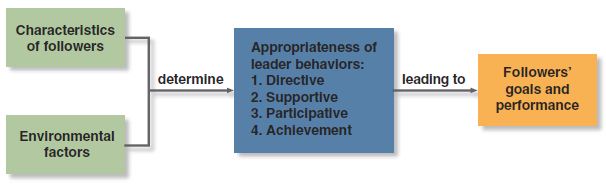
Situational

2. Situational Leadership Theory

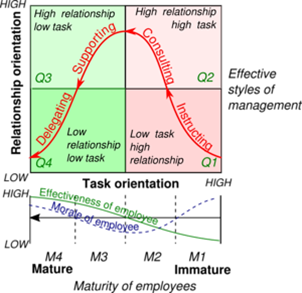
Hersey and Blanchard (1977) proposed a contingency theory called Situational Leadership Theory. According to proponents of the situational approach to leadership, universally important traits and behaviors don’t exist. It specifies the appropriate type of leadership behavior for a subordinate in various situations. Behavior was defined in terms of the directive and supportive leadership, and a revised version of the theory also included decision procedures (Graef, 1997). The situational variable is subordinate maturity, which includes the person’s ability and confidence to do a task.

According to the theory, for a low-maturity subordinate the leader should use substantial task-oriented behavior such as defining roles, clarifying standards and procedures, directing the work, and monitoring progress. As subordinate maturity increases up to a moderate level, the leader can decrease the amount of task-oriented behavior and increase the amount of relations-oriented behavior (e.g., consult with the subordinate, provide more praise and attention). For high-maturity subordinates, the leader should use extensive delegation and only a limited amount of directive and supportive behavior. A high-maturity subordinate has the ability to do the work
without much direction or monitoring by the leader, and the confidence to work without much supportive behavior by the leader.
HnB

The primary focus of the theory is on short-term behavior, but over time the leader may be able to increase subordinate maturity with a developmental intervention that builds the person’s skills and confidence. How long it takes to increase subordinate maturity depends on the complexity of the task and the subordinate’s initial skill and confidence. It may take as little as a few days or as long as a few years to advance a subordinate from low to high maturity on a given task. Hersey and Blanchard recognized that subordinate maturity may also regress, requiring a flexible adjustment of the leader’s behavior. For example, after a personal tragedy such as the death of loved ones, a subordinate who was highly motivated may become apathetic. In this situation, the leader should increase supervision and use a developmental intervention designed to restore maturity to the former high level.

The situational variables include characteristics of the subordinates, task, and the organization that serve as substitutes by directly affecting the dependent variable and making the leader behavior redundant. The substitutes for instrumental leadership include a highly structured and repetitive task, extensive rules and standard procedures, and extensive prior training and experience for subordinates.

The substitutes for supportive leadership include a cohesive workgroup in which the members support each other and an intrinsically satisfying task that is not stressful. In a situation with many substitutes, the potential impact of leader behavior on subordinate motivation and satisfaction may be greatly reduced. For example, little direction is necessary when subordinates have extensive prior experience or training, and they already possess the skills and knowledge to know what to do and how to do it. Likewise, professionals who are internally motivated by their values, needs, and ethics do not need to be encouraged by the leader to do high-quality work.


3. Fiedler’s Contingency Model

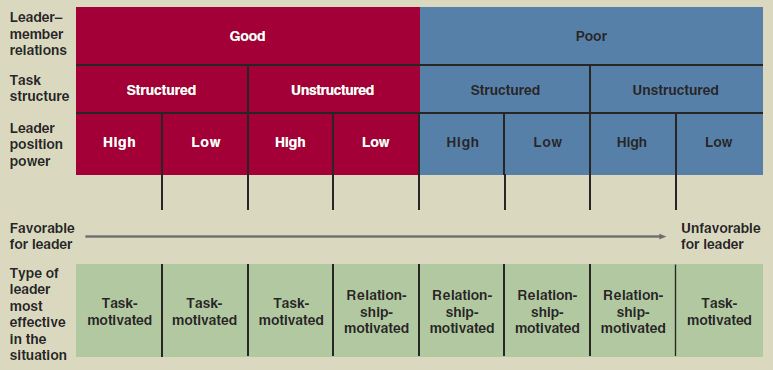
According to Fiedler’s contingency model of leadership effectiveness, effectiveness depends on two factors: the personal style of the leader and the degree to which the situation gives the leader power, control, and influence over the situation. The figure below illustrates the contingency model:
LPC

The upper half of the figure shows the situational analysis, and the lower half indicates the appropriate style. In the upper portion, three questions are used to analyze the situation:

  1. Are leader-member relations good or poor? (To what extent is the leader accepted and supported by group members?)
  2. Is the task structured or unstructured? (To what extent do group members know what their goals are and how to accomplish them?)
  3. Is the leader’s position power strong or weak (high or low)? (To what extent does the leader have the authority to reward and punish?)

These three sequential questions create a decision tree (from top to bottom in the figure) in which a situation is classified into one of eight categories. The lower the category number, the more favorable the situation is for the leader; the higher the number, the less favorable the situation. Fiedler originally called this variable “situational favorableness,” and later “situational control.” Situation 1 is the best: relations are good, task structure is high, and power is high. In the least favorable situation (8), in which the leader has very little situational control, relations are poor, tasks lack structure, and the leader’s power is weak.

Different situations dictate different leadership styles. Fiedler measured leadership styles with an instrument assessing the leader’s least preferred co-worker (LPC); that is, the attitude toward the follower the leader liked the least. This was considered an indication more generally of leaders’ attitudes toward people. If a leader can single out the person she likes the least, but her attitude is not all that negative, she would receive a high score on the LPC scale. Leaders with more negative attitudes toward others would receive low LPC scores.

Based on the LPC score, Fiedler considered two leadership styles. Task-motivated leadership places primary emphasis on completing the task and is more likely exhibited by leaders with low LPC scores. Relationship-motivated leadership emphasizes maintaining good interpersonal relationships and is more likely from high-LPC leaders. These leadership styles correspond to task performance and group maintenance leader behaviors, respectively.

taskDISCUSSION

As organizations become flatter (that is, fewer hierarchical levels) and more globally and technologically interconnected, old leadership theories will become outdated. Although the three elements of leadership—the leader, the followers, and the situation—will still be part of the whole leadership equation, how these three elements interact to successfully accomplish a team’s mission and goals are changing. Successful leaders in tomorrow’s workplaces will need to be more like chameleons, adapting to complex and dynamic environments. 


Discussion Question 1: Why are old leadership theories becoming outdated?

Discussion Question 2: “Without people, leaders are nothing”. What does this mean?

> POST YOUR ANSWER HERE <


--------------------------------------------------

Multiple-linkage Model

The multiple-linkage model (Yukl, 1981, 1989) was developed after the other early contingency theories, and it includes ideas from some of those theories. However, the broadly defined leadership behaviors in most earlier theories were replaced by more specific types of behaviors. Other unique features include a larger number of mediating and situational variables, and a more explicit description of group-level processes. The explanation of how these variables are relevant includes ideas from the literature on motivation, organization theory, and team leadership. The multiple-linkage model describes how managerial behavior and situational variables jointly influence the performance of individual subordinates and the leader’s work unit. The four types of variables in the model include managerial behaviors, mediating variables, criterion variables, and situational variables.

Mediating Variables

The mediating variables are defined primarily at the group level, like theories of team leadership:

  1. Task commitment: members strive to attain a high level of performance and show a high degree of personal commitment to unit task objectives.
  2. Ability and role clarity: members understand their individual job responsibilities, know what to do, and have the skills to do it.
  3. Organization of the work: effective performance strategies are used and the work is organized to ensure efficient utilization of personnel, equipment, and facilities.
  4. Cooperation and mutual trust: members trust each other, share information and ideas, help each other, and identify with the work unit.
  5. Resources and support: the group has budgetary funds, tools, equipment, supplies, personnel, facilities, information, and assistance needed to do the work.
  6. External coordination: the activities of the group are synchronized with the interdependent activities in other subunits and organizations (e.g., suppliers, clients).

Situational Variables

Situational variables directly influence mediating variables and can make them either more or less favorable. Situational variables also determine the relative importance of the mediating variables as a determinant of group performance. Mediating variables that are both important and deficient should get top priority for corrective action by a leader. Conditions that make a mediating variable more favorable are similar to “substitutes” for leadership. In a very favorable situation, some of the mediating variables may already be at their maximum short-term level, making the job of the leader much easier. Situational variables affecting each mediating variable are briefly described in this section.

Situational variables that can influence task commitment include the formal reward system and the intrinsically motivating properties of the work itself. Subordinate task commitment is more important for complex tasks that require high effort and initiative and have a high cost for any errors. Member commitment to perform the task effectively will be greater if the organization has a reward system that provides attractive rewards contingent on performance, as in the case of many sales jobs. Intrinsic motivation is likely to be higher for subordinates if the work requires varied skills, is interesting and challenging, and provides automatic feedback about performance.


Short-Term Actions to Correct Deficiencies

A basic proposition of the theory is that leader actions to correct any deficiencies in the mediating variables will improve group performance. A leader who fails to recognize opportunities to correct deficiencies in key mediating variables, who recognizes the opportunities but fails to act, or who acts but is not skilled will be less than optimally effective. An ineffective leader may make things worse by acting in ways that increase rather than decrease the deficiency in one or more mediating variables. For example, a leader who is very manipulative and coercive may reduce subordinate effort rather than increasing it.

Types of Specific Actions for Improving Weak Performance Determinants

Low subordinate task commitment or confidence

  • Set challenging goals and express confidence they can be achieved.
  • Articulate an appealing vision of what the group can accomplish.
  • Use influence tactics to influence task commitment.
  • Offer more incentives for goal attainment.

Low subordinate task knowledge and skills

  • Make clear assignments.
  • Provide more direction and clarification of procedures.
  • Provide instruction and coaching when needed.
  • Find skilled people to do difficult tasks.

Low coordination and inefficient procedures for the work

  • Find ways to make better use of members, resources, and equipment.
  • Identify and eliminate inefficient or unnecessary activities.
  • Provide clear, decisive direction of activities.
  • Develop better plans for achieving task objectives.

Inadequate resources to do the work

  • Find more reliable or alternative sources of resources.
  • Request more resources from the organization.
  • Identify ways to avoid wasted sources.
  • Find more efficient ways to use resources.

Weak external coordination

  • Develop better plans to avoid external coordination problems.
  • Improve external relations with interdependent units.
  • Consult more often with interdependent units to coordinate actions.
  • Monitor closely to detect external coordination problems quickly.


Long-Term Effects on Group Performance

Over a longer period of time, leaders can make larger improvements in group performance by modifying the situation to make it more favorable. Effective leaders act to reduce constraints, increase substitutes, and reduce the importance of mediating variables that are not amenable to improvement. These effects usually involve sequences of related behaviors carried out over a long time period. More research has been conducted on short-term behaviors by leaders than on the long-term behaviors to improve the situation. Useful insights are provided by literature on leading change, making strategic decisions, and representing the team or work unit.

  1. Gain more access to resources needed for the work by cultivating better relationships with suppliers, finding alternative sources, and reducing dependence on unreliable sources.
  2. Gain more control over the demand for the unit’s products and services by finding new customers, opening new markets, advertising more, and modifying the products or services to be more acceptable to clients and customers.
  3. Initiate new, more profitable activities for the work unit that will make better use of personnel, equipment, and facilities.
  4. Initiate long-term improvement programs to upgrade equipment, and facilities in the work unit (e.g., replace old equipment, implement new technology).
  5. Improve selection procedures to increase the level of employee skills and commitment.
  6. Modify the formal structure of the work unit to solve chronic problems and reduce demands on the leader for short-term problem-solving.

----------------------------------------------------------------


Guidelines for Adaptive Leadership

In order to be effective, leaders need to adapt their behavior to changing situations. The following guidelines can help leaders be more flexible and adaptive to their situation. The guidelines are based on findings in research on contingency theories and other research using descriptive methods.

  • Understand your leadership situation and try to make it more favorable.
  • Learn how to use a wide range of relevant behaviors.
  • Identify effective behaviors for your objectives and situation.
  • Use more planning for a long, complex task.
  • Provide more direction to people with interdependent roles.
  • Monitor a critical task or unreliable person more closely.
  • Provide more instruction and coaching to an inexperienced subordinate.
  • Be more supportive of someone with a highly stressful task.


Guidelines for Managing Immediate Crises

One type of leadership situation that is especially challenging is an immediate crisis or disruption that endangers the safety of people or the success of an activity. Examples of this type of crisis include pandemic, serious accidents, explosions, natural disasters, equipment breakdowns, product defects, sabotage of products or facilities, supply shortages, health emergencies, employee strikes, sabotage, a terrorist attack, or a financial crisis.

  • Anticipate problems and prepare for them.
  • Learn to recognize early warning signs for an impending problem.
  • Quickly identify the nature and scope of the problem.
  • Direct the response by the unit or team in a confident and decisive way.
  • Keep people informed about a major problem and what is being done to resolve it.
  • Use a crisis as an opportunity to make necessary changes.