Showing posts with label organizational behaviour. Show all posts

Tuesday, December 23, 2025

Management Series: Leading in a Cross-Culture and Diversity Environment

 Cross-Culture & Diversity

After studying this topic, you should be able to:

  • Discuss why cross-cultural research on leadership is important.
  • Assess how cultural values are related to leader behavior.
  • Identify and apply the essentials for effective global leadership.
  • Manage diversity and provide equal opportunities.

middle east workforce

  • Globalization and changing demographic patterns are making it more important for leaders to understand how to influence and manage people with different values, beliefs, and expectations. The diversity of people in leadership positions is also increasing, and there is strong interest in studying whether the ability to provide effective leadership is related to a person’s gender, age, race, ethnic background, national origin, religion, sexual preference, or physical appearance (height, weight, attractiveness).
  • Cultural values and traditions can influence the attitudes and behavior of managers in a number of different ways. The values are likely to be internalized by managers who grow up in a particular culture, and these values will influence their attitudes and behavior in ways that may not be conscious. In addition, cultural values are reflected in social norms about the way people relate to each other. Cultural norms specify acceptable forms of leadership behavior and may be formalized as social laws limiting the use of power. Most managers will conform to social norms about acceptable behavior, even if they have not internalized the norms. One reason is that deviation from social norms may result in diminished respect and increased social pressure from other members of the organization. Another reason for conformity with social norms is that the use of socially unacceptable forms of behavior is likely to undermine a leader’s effectiveness.
  • Even when some types of leadership behaviors are not clearly supported by the prevailing cultural values and traditions in a country, it does not necessarily mean that these behaviors are ineffective. Managers who have little experience with a particular type of leadership behavior may not understand how effective it could be.
  • The values and traditions in a national culture can change over time, just as they do in organizational culture. Cultural values are influenced by many types of changes (e.g., economic, political, social, technological). Countries in which socialism is being replaced by capitalism and emphasis on entrepreneurship are likely to see a shift toward stronger individualism and performance orientation values. Countries in which an autocratic political system is replaced by a democratic system are likely to become more accepting of participative leadership and empowerment in organizations. Countries in which strong gender differentiation is gradually replaced by gender equality can be expected to become more accepting of leadership practices that reflect traditional feminine attributes (e.g., nurturing, developing, building cooperative relationships). Cultural values and beliefs about the determinants of effective leadership are likely to change in a consistent way.


Cultural Value Dimensions and Leadership

This section summarizes major findings in the research on how current cultural values are related to leadership beliefs, leadership behavior, and leadership development practices. The six value dimensions to be discussed include (1) power distance, (2) uncertainty avoidance, (3) individualism versus collectivism, (4) gender egalitarianism, (5) performance orientation, and (6) humane orientation.

Image source: https://hespinterpretation.com/2019/11/01/hofstedes-cultural-dimensions-and-assessment-of-cultural-and-linguistically-diverse-clients/

1.Power Distance

Power distance involves the acceptance of an unequal distribution of power and status in organizations and institutions. In high power distance cultures, people expect the leaders to have greater authority and are more likely to comply with rules and directives without questioning or challenging them (Dickson et al., 2003). Subordinates are less willing to challenge bosses or express disagreement with them (Adsit, London, Crom, & Jones, 1997). More formal policies and rules are used, and managers consult less often with subordinates when making decisions.

Participative leadership is viewed as a more favorable leadership attribute in low power distance cultures such as Western Europe, New Zealand, and the United States than in high power distance countries such as Russia, China, Taiwan, Mexico, and Venezuela (Dorfman, Hanges, & Brodbeck, 2004).

2.Uncertainty Avoidance

In cultures with high avoidance of uncertainty, there is more fear of the unknown, and people desire more security, stability, and order. Social norms, tradition, detailed agreements, and certified expertise are more valued because they offer a way to avoid uncertainty and disorder. Examples of countries with high uncertainty avoidance include France, Spain, Germany, Switzerland, Russia, and India. Some countries with
a lower concern about avoiding uncertainty include the United States, United Kingdom, Canada,
Denmark, and Sweden.

When there is high uncertainty avoidance, valued qualities for managers include being reliable, orderly, and cautious, rather than flexible, innovative, and risk-taking. Managers use more detailed planning, formal rules and standard procedures, and monitoring of activities, and there is less delegation

3.Individualism (versus Collectivism)

Individualism is the extent to which the needs and autonomy of individuals are more important than the collective needs of groups, organizations, or society. In an individualistic culture, individual rights are more important than social responsibilities, and people are expected to take care of themselves (Dickson et al., 2003; Gelfand, Bhawuk, Nishi, & Bechtold, 2004; Hofstede, 1980). Examples of countries with strong values for individualism include the United States, Australia, England, and the Netherlands. 

Because people are more motivated to satisfy their self‐interests and personal goals in an individualistic culture, it is more difficult for leaders to inspire strong commitment to a team or organizational objectives (Jung & Avolio, 1999; Triandis et al., 1993). The preference for rewards based on individual achievements and performance also makes it more difficult for leaders to use team‐based rewards and recognition.

4.Gender Egalitarianism (Masculinity)

Gender egalitarianism is the extent to which men and women receive equal treatment, and both masculine and feminine attributes are considered important and desirable. In cultures with high gender egalitarianism, there is less differentiation of sex roles and most jobs are not segregated by gender. Women have a more equal opportunity to be selected for important leadership positions, although access is still greater for public sector positions than in business corporations. In the absence of strongly differentiated gender‐role expectations, men and women leaders are less limited in their behavior, and there is less bias in how their behavior is evaluated by subordinates and by bosses. Examples of countries with strong gender egalitarian values include Norway, Sweden, Denmark, and the Netherlands. Countries with a low level of gender egalitarianism include Japan, Italy, Mexico, and Switzerland. 

Participative leadership, supportive leadership, and relations‐oriented aspects of transformational leadership are viewed less favorably in cultures with low gender egalitarianism. Leaders are more likely to use direct, confrontational forms of interpersonal influence rather than indirect, subtle forms of influence. Leaders whose actions display humility, compassion, or conciliation are more likely to be viewed as weak and ineffective in a “masculine” culture.

5.Performance Orientation (Long-Term)

In a high-performance orientation culture, there is more emphasis on leader behaviors that are relevant for improving performance and efficiency. Examples include setting challenging goals or standards, developing action plans with schedules and deadlines, expressing confidence that subordinates can improve performance, developing job‐relevant skills in subordinates, encouraging initiative, and providing praise and rewards for achievements. In a high-performance orientation culture, the selection of members for a team with an important task is likely to be based on talent, not on friendship or family relations.

A strong concern for task performance is widely believed to be a requirement for effective leadership in any country. Economic development is aided by a strong performance orientation, but concern for improving performance may be stronger in rapidly developing countries than in a country where widespread prosperity already exists.

6.Humane Orientation (Indulgence)

Humane orientation means a strong concern for the welfare of other people and the willingness to sacrifice one’s own self‐interest to help others. Key values include altruism, benevolence, kindness, compassion, love, and generosity. These values tend to be associated with stronger needs for affiliation and belongingness than for pleasure, achievement, or power. Altruism and kindness are not limited to a person’s family or ethnic/religious in‐group, but instead, include a humanitarian concern for everyone. Societies with a strong humane orientation encourage and reward individuals for being friendly, caring, generous, and kind to others. Such societies are likely to invest more resources in educating and training people for careers and in providing health care and social services to people. The humane values for an individual are influenced by family experiences, parenting, and religious teaching as well as by cultural norms. 

A leader with strong humane orientation values is likely to be more tolerant, patient, and helpful with subordinates who make mistakes or are having difficulty learning a new task. Humane orientation values are also associated with participative leadership, servant leadership, and team‐building behaviors (encouraging cooperation and mutual trust). The key values are consistent with a diplomatic, conciliatory style of conflict management that seeks to restore harmonious relations and satisfy each party’s important needs.

Additional Reference: https://geerthofstede.com/culture-geert-hofstede-gert-jan-hofstede/6d-model-of-national-culture/


idea2  REFLECTION

  1. Compare the cultural dimensions of any TWO (2) countries you intend to work in.
  2. Based on the comparison, which one do you prefer & the best for your managerial-style? Justify.

Cultural dimensions comparisonhttps://www.hofstede-insights.com/product/compare-countries/ 


> CLICK HERE TO REFLECT <


Culture Clusters

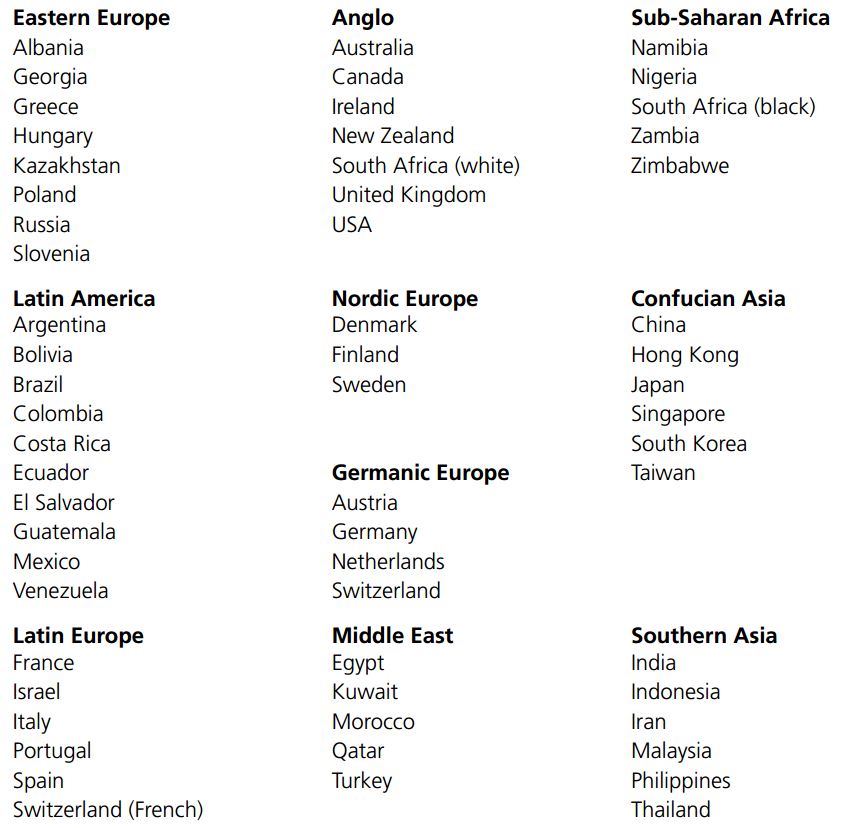
The cultural value dimensions are moderately inter-correlated, and examining differences for a single value dimension without controlling for the others makes it difficult to determine their independent effects on leadership beliefs and behavior. For example, in a country that has high power distance and low uncertainty tolerance, it is not clear how much each value influences the emphasis on centralized decisions for a company. For this reason, researchers have grouped countries into clusters based on regional proximity and similarity in language, ethnic background, and religion (Dorfman et al., 2004; Gupta, Hanges, & Dorfman, 2002).

The GLOBE researchers grouped 60 countries into 10 clusters, and a discriminant analysis confirmed that the classification of countries into clusters accurately reflected differences in the nine cultural values for each country. The nations in each cluster are shown below:
Globe


taskSELF-CHECK

What’s Your Cultural Profile? Use the self-assessment link below to identify your culture profile. Then, comment on your results.

Self-Assessment Test by Erin Meyer: https://hbr.org/web/assessment/2014/08/whats-your-cultural-profile ttps://hbr.org/web/assessment/2014/08/whats-your-cultural-profile


genderGender and Leadership

Widespread discrimination is clearly evident in the low number of women who hold important, high‐level leadership positions in most types of organizations. The strong tendency to favor men over women in filling high‐level leadership positions has been referred to as the “glass ceiling.” Only a small number of nations have a female head of state (e.g., prime minister, president), and the number of women in top executive positions in large business organizations are also very small, although it has been increasing in recent years. In the complete absence of sex‐based discrimination, the number of women in chief executive positions in business and government should be close to 50 percent.


Theories of Male Advantage vs Theory of Feminine Advantage

Gender-based discrimination was supported by age-old beliefs that men are more qualified than women for leadership roles. These beliefs involved assumptions about the traits and skills required for effective leadership in organizations (implicit theories), assumptions about inherent differences between men and women (gender stereotypes), and assumptions about appropriate behavior for men and women (role expectations). As noted earlier, the implicit theories and gender stereotypes are also influenced by cultural values for gender egalitarianism. 

A more recent controversy is fueled by claims that women are more likely than men to possess the values and skills necessary for effective leadership in modern organizations. The difference is a result of childhood experiences, parent-child interactions, and socialization practices that reflect cultural sex‐role stereotypes and beliefs about gender differences and appropriate occupations for men and women.

These experiences encourage “feminine” values such as kindness, compassion, nurturing, and sharing. Proponents of the “feminine advantage” theory contend that women are more concerned with consensus building, inclusiveness, and interpersonal relations; they are more willing to develop and nurture subordinates and share power with them. Women are believed to have more empathy, rely more on intuition, and be more sensitive to feelings and the quality of relationships.

More systematic and comprehensive research is needed to determine the extent of any gender differences in leadership and the reasons for them. It is essential to examine how organizational and cultural factors influence the perceptions and behaviors that shape gender identity.

--------------------------------------------------------------------


Managing Diversity

Diversity can take many forms, including differences in race, ethnic identity, age, gender, education, physical appearance, socioeconomic level, and sexual orientation. More women are entering traditionally male jobs, the number of older workers is increasing, and there is more diversity with regard to ethnic, religious, and racial backgrounds. The increasing number of joint ventures, mergers, and strategic alliances is bringing together people from different types of organizations and national cultures.


reading-icon-png-319035-free-icons-library-read-png-512_512

 READING:


The Key to Inclusive Leadership

Bourke, J. and Espedido, A. (2020). The key to Inclusive Leadership. Harvard Business Review (Accessed on August 24, 2020: URL: https://hbr.org/2020/03/the-key-to-inclusive-leadership)

(Download Pdf) (0 views/downloads)

> POST YOUR REFLECTION HERE <


A greater variety of perspectives increases creativity, and full utilization of a diverse workforce will increase the amount of available talent for filling important jobs. However, diversity can also result in more distrust and conflict, lower satisfaction, and higher turnover. An organization is less likely to have shared values and strong member commitment when it has many diverse members who identify primarily with their own subgroup. Thus, managing diversity is an important but difficult responsibility of leaders in the twenty‐first century.

taskSELF-CHECK & REFLECTION

1. Do you consider yourself an Inclusive Leader?

Use the link below to find out: https://www.catalyst.org/research/quiz-are-you-an-inclusive-leader/ 


2. Do you agree with the results? Reflect and give an example of how you can become an Inclusive Leader.

> CLICK HERE TO REFLECT <s://www.catalyst.org/research/quiz-are-you-an-inclusive-leader/


Guidelines for Managing Diversity and Promoting Inclusion

Encourage Tolerance & Appreciation

  • Set an example in your own behavior of appreciation for diversity.
  • Encourage respect for individual differences.
  • Promote understanding of different values, beliefs, and traditions.
  • Explain the benefits of diversity for the team or organization.
  • Encourage and support others who promote tolerance of diversity.

Discourage Intolerance & Discrimination

  • Discourage the use of stereotypes to describe people.
  • Identify biased beliefs and role expectations for women or minorities.
  • Challenge people who make prejudiced comments.
  • Speak out to protest against unfair treatment based on prejudice.
  • Take disciplinary action to stop harassment of women or minorities.


To make full use of the talent represented by the diverse members of the organization, it is essential to eliminate constraints that prevent qualified people from selection for important positions. Many things can be done to facilitate equal opportunity and reduce discrimination in personnel decisions.

An important responsibility for leaders in this new century is the management of diversity, which can take many forms. Leaders play an essential role in helping to bring about equal opportunity and elimination of unfair discrimination in selection and promotion decisions. Leaders can do many things to encourage tolerance and appreciation of diversity in organizations. All leaders in the organization should share the responsibility for improving diversity and ensuring equal opportunity. Leadership at the national level is also important in the continuing efforts to eliminate unfair discrimination for all minorities and ethnic groups.

Management Series: Leading Change And Innovation

 Leading Change & Innovation

After studying this topic, you should be able to:

  • Identify reasons for resisting change.
  • Describe the psychological processes involved in making major changes.
  • Discuss the process of implementing a major change in an organization.
  • Examine how leaders can increase learning and innovation.

Leading change is one of the most important and difficult responsibilities for managers and administrators. It involves guiding, encouraging, and facilitating the collective efforts of members to adapt and survive in an uncertain and sometimes hostile environment. For some theorists, this is the essence of leadership. The major change in an organization is usually guided by the top management team, but other members of the organization can initiate change or contribute to its success.


Types of Change in Teams and Organizations

Many types of changes can be made by leaders, and some types are more difficult than others. The focus of a change effort may involve roles, attitudes, technology, strategy, economics, or people.

1. Roles or Attitudes

One useful distinction is between efforts to change attitudes versus efforts to change roles, structures, and procedures (Beer, Eisenstat, & Spector, 1990). The attitude-centered approach involves changing attitudes and values with persuasive appeals, training programs, team-building activities, or a culture change program. In addition, technical or interpersonal skills may be increased with a training program. The underlying assumption is that new attitudes and skills will cause behaviour to change in a beneficial way. The leader seeks to convert resisters into change agents who will transmit the vision to other people in the organization

It involves changing work roles by reorganizing the workflow, redesigning jobs to include different activities and responsibilities, modifying authority relationships, changing the criteria and procedures for evaluation of work, and changing the reward system. The assumption is that when work roles require people to act in a different way, they will change their attitudes to be consistent with the new behaviour. Effective behaviour is induced by the new role requirements and reinforced by the evaluation and reward system.

2. Technology

Many organizations have attempted to improve performance by implementing new information and decision support systems. Examples include networked workstations, human resource information systems,
inventory and order processing systems, sales tracking systems, or an intranet with groupware for communication and idea-sharing among employees. Such changes often fail to yield the desired benefits, because, without consistent changes in work roles, attitudes, and skills, the new technology will not be accepted and used in an effective way.

3. Strategy

Another major type of change is in the competitive strategy for achieving the major objectives of the team or organization. Examples of strategy changes for a company include the introduction of new products or services, entering new markets, use of new forms of marketing, initiation of Internet sales in addition to direct selling, forming alliances or joint ventures with other organizations, and modifying relationships with suppliers (e.g., partnering with a few reliable suppliers). To be successful, changes in the competitive strategy may require consistent changes in people, work roles, organization structure, and technology.

4.Economies or People

Internal changes in an organization may emphasize economics or people. The first approach seeks to improve financial performance with changes such as downsizing, restructuring, and adjustments in compensation and incentives.

The second approach seeks to improve human capability, commitment, and creativity by increasing individual and organizational learning, strengthening cultural values that support flexibility and innovation, and empowering people to initiate improvements.

-------------------------------------------------------------------


Change Processes

Change process theories describe a typical pattern of events that occur from the beginning of a change to the end, and in some cases they describe how earlier changes affect subsequent changes. The theories may identify distinct phases in the process, stages in the reaction of individuals, or effects of repeated changes on people.


1. Stages in the Change Process

One of the earliest process theories was Lewin’s (1951) force-field model. He proposed that the change process can be divided into three phases: unfreezing, changing, and refreezing.

In the unfreezing phase, people come to realize that the old ways of doing things are no longer adequate. This recognition may occur as a result of an obvious crisis, or it may result from an effort to describe threats or opportunities that were not evident to most people in the organization. In the changing phase, people look for new ways of doing things and select a promising approach. In the refreezing phase, the new approach is implemented and it becomes established. All three phases are important for successful change. An attempt to move directly to the changing phase without first unfreezing attitudes is likely to meet with apathy or strong resistance. Lack of systematic diagnosis and problem solving in the changing phase will result in a weak change plan. Lack of attention to consensus building and maintenance of enthusiasm in the third stage may result in the change being reversed soon after it is implemented.

According to Lewin, change may be achieved by two types of actions. One approach is to increase the driving forces toward change (e.g., increase incentives and use position power to force change). The other approach is to reduce restraining forces that create resistance to change (e.g., reduce fear of failure or economic loss, co-opt, or remove opponents). If the restraining forces are weak, it may be sufficient merely to increase driving forces. However, when restraining forces are strong, a dual approach is advisable. Unless restraining forces can be reduced, an increase in driving forces will create an intense conflict over the change, and continuing resistance will make it more difficult to complete the refreezing phase.


2. Stages in Reaction to a Change

The reaction pattern has four stages: denial, anger, mourning, and adaptation. The initial reaction is to deny that change will be necessary (“This isn’t happening” or “It’s just a temporary setback”). The next stage is to get angry and look for someone to blame. At the same time, people stubbornly resist giving up accustomed ways of doing things. In the third stage, people stop denying that change is inevitable, acknowledge what has been lost, and mourn it. The final stage is to accept the need to change and go on with one’s life. The duration and severity of each type of reaction can vary greatly, and some people get stuck in an intermediate stage.

Understanding these stages is important for change leaders, who must learn to be patient and helpful. Many people need help to overcome denial, channel their anger constructively, mourn without becoming severely depressed, and have optimism about adjusting successfully.


3. Prior Experience and Reactions to Change

How a person reacts to change depends in part on the person’s general confidence in coping with change successfully. This confidence is affected by prior experience with change as well as by traits, such as self-confidence, risk tolerance, openness to new experiences, and internal locus of control orientation (Erwin & Garman, 2010).

One hypothesis is that experiencing traumatic change will “inoculate” people and leave them better prepared to change again without such an intense or prolonged period of adjustment. For example, having experienced and survived the loss of two jobs in five years, Sally is confident about taking more risky, less secure jobs in the future.

However, even for people with strong confidence in their ability to handle change, frequent changes in a short period of time can undermine commitment. People are likely to feel frustration and a sense of injustice if the burden of implementing change is placed on them without adequate support from the organization. Feelings of being unjustly treated are intensified when most of the benefits of the changes will accrue to others, such as owners and top management. 

--------------------------------------------------------------------


Reasons for Accepting or Rejecting Change

Many efforts to implement major change in an organization are unsuccessful and resistance to change is a major reason for failure. One explanation for the outcome of a proposed change is in terms of leader power and the types of influence processes that leaders use.

Compliance with the change is likely if people believe that it is a legitimate exercise of leader authority (legitimate power), or if they fear punishment for resisting the change (coercive power). Commitment to supporting a change initiative is likely when people trust their leaders and believe that the change is necessary and effective (strong referent and expert power). However, resistance to change is common in organizations, and it can occur for several reasons that are not mutually exclusive:

  • The Proposed Change Is Not Necessary
  • The Proposed Change Is Not Feasible
  • The Proposed Change Is Not Cost-Effective
  • The Proposed Change Would Cause Personal Losses
  • The Proposed Change Is Inconsistent with Values
  • The Leaders Are Not Trusted
  • Organizational Cynicism About Change
  • Alternative Reasons for Resistance

Resistance to change is not merely the result of ignorance or inflexibility. It can occur for several reasons and is a natural reaction by people who want to protect their self-interests and sense of self-determination. Rather than viewing resistance only as an obstacle to batter down or circumvent, it can be viewed as the energy that can be redirected to improve change. Active resistance indicates the presence of strong values and emotions that could serve as a source of commitment if opponents are converted to supporters. It is essential to discuss a proposed change with the people who will be affected to learn about their concerns and their ideas about the best course of action

--------------------------------------------------------------------


Implementing Change

The outcomes for a change can be judged in different ways, including commitment of people to the change, successful implementation of the change, and the extent to which the change results in the desired benefits and avoids negative consequences.


1.Determining What to Change

Before initiating major changes, leaders need to be clear about the nature of the problem and the objectives to be achieved. Just as in the treatment of a physical illness, the first step is a careful diagnosis to determine what is wrong with the patient. The organizational diagnosis can be conducted by the top management team, by outside consultants, or by a task force composed of representatives of the various key stakeholders in the organization.

2.Understanding Systems Dynamics

Knowledge of systems dynamics is helpful both for identifying the nature of a problem and for anticipating the likely effects of changes made to resolve it. Problems have multiple causes, which may include actions taken earlier to solve other problems. If the diagnosis only identifies one of several problems, the changes may fail to achieve the desired outcome. In large systems such as organizations, actions have multiple outcomes, including unintended side effects.

A change in one part of a system will eventually affect other parts, and reactions to the change may cancel out the effects. Changes that have delayed effects tend to obscure the real nature of the relationship.

3.Responsibility for Implementing Major Change

Large-scale change in an organization is unlikely to be successful without the support of top management. However, contrary to common assumptions, major changes are not always initiated by top management, and they may not become involved until the process is well underway.

Major changes suggested by lower levels may be resisted by top managers who are strongly committed to traditional approaches and do not understand that the old ways of doing things are no longer appropriate.

The essential role of top management in implementing change is to formulate an integrating vision and general strategy, build a coalition of supporters who endorse the strategy, then guide and coordinate the process by which the strategy will be implemented. Complex changes usually involve a process of experimentation and learning, because it is impossible to anticipate all the problems or to prepare detailed plans for how to carry out all aspects of the change.

4.The Pace and Sequencing of Changes

Whenever feasible it seems beneficial to change interdependent subunits of the organization simultaneously so that the effects will be mutually supporting. However, in a large organization with semi-autonomous subunits (e.g., separate product divisions) simultaneous change is not essential, and it may not be feasible to implement change in all subunits at the same time. One way to demonstrate the success of a new strategy is to implement it on a small scale in one subunit or facility on an experimental basis.

A successful change that is carried out in one part of an organization can help to stimulate similar changes throughout the organization. Successful implementation of a major new strategy usually requires a change in the organizational structure to make it consistent with the strategy. However, when structural change is likely to be resisted, it may be easier to create an informal structure to support the new strategy and postpone changes in the formal structure until people realize that they are needed. Informal teams can be created to facilitate the transition, without any expectation that these temporary structures will become permanent.

For example, after temporary task forces were created to plan and coordinate changes in one company, they eventually evolved into permanent cross-functional committees with formal authority to plan and monitor continuing improvements in product quality and operational procedures.

--------------------------------------------------------------------


Guidelines for Implementing Change

Successful implementation of change in organizations requires a wide range of leadership behaviors. Some of the behaviors involve political and administrative aspects, and others involve motivating, supporting, and guiding people. Even the people who initially endorse a change will need support and assistance to sustain their enthusiasm and optimism as the inevitable difficulties and setbacks occur. The major change is always stressful and painful for people, especially when it involves a prolonged transition period of adjustment, disruption, and dislocation. The following guidelines describe current thinking about the best way to implement a major change in an organization:

  • Creating a sense of urgency about the need for change.
  • Communicate a clear vision of the benefits to be gained from change.
  • Identify likely supporters, opponents, and reasons for resistance.
  • Build a broad coalition to support the change.
  • Use task forces to guide the implementation of changes.
  • Fill key positions with competent change agents.
  • Empower competent people to help plan and implement the change.
  • Make dramatic, symbolic changes that affect the work.
  • Prepare people for change by explaining how it will affect them.
  • Help people deal with the stress and difficulties of major change.
  • Provide opportunities for early successes to build confidence.
  • Monitor the progress of change and make any necessary adjustments.
  • Keep people informed about the progress of change.
  • Demonstrate optimism and continued commitment to the change.

---------------------------------------------------------------------


How Visions Influence Change

The success of a major change will depend to a great extent on how well leaders communicate the reasons why the proposed change is necessary and beneficial. Success is more likely if leaders articulate a vision of a better future that is attractive enough to justify the sacrifices and hardships the change will require. The vision can provide a sense of continuity for followers by linking past events and present strategies to a vivid image of a better future for the organization. The vision provides hope for a better future and the faith that it will be attained someday. In the hectic and confusing process of implementing change, a clear vision helps to guide and coordinate the decisions and actions of many people in widely dispersed locations.


1. Desirable Characteristics for a Vision

  • A vision should be simple and idealistic, a picture of a desirable future, not a complex plan with quantitative objectives and detailed action steps.
  • The vision should appeal to the values, hopes, and ideals of organization members and other stakeholders whose support is needed. The vision should emphasize distant ideological objectives rather than immediate tangible benefits.
  • The vision should be challenging but realistic. To be meaningful and credible, it should not be a wishful fantasy, but rather an attainable future grounded in the present reality.
  • The vision should address basic assumptions about what is important for the organization, how it should relate to the environment, and how people should be treated.
  • The vision should be focused enough to guide decisions and actions, but general enough to allow initiative and creativity in the strategies for attaining it.
  • Finally, a successful vision should be simple enough to be communicated clearly in five minutes or less.


2. Elements of a Vision

The mission statement usually describes the purpose of the organization in terms of the type of activities to be performed for constituents or customers. In contrast, an effective vision tells us what these activities mean to people. The core of the vision is the organization’s mission, but different aspects of it may be emphasized.

Value statement is a list of the key values or ideological themes considered important for an organization. The values usually pertain to the treatment of customers, treatment of organization members, core competencies, and standards of excellence. Common themes include satisfying customers, achieving excellence in products or services, providing an innovative product or service, developing and empowering employees, and making important contributions to society. A value statement provides a good beginning for developing a more complete vision. However, just listing values does not clearly explain their relative priority, how they are interrelated, or how they will be expressed and achieved. An effective vision statement provides a glimpse of a possible future in which all the key values are realized at the same time.

Slogans are statements used to summarize and communicate values in simple terms. However, a slogan is limited in how many values can be expressed. Consider the following examples: technology is our business, quality is job one, we feel good when you feel good, all the news people want to read, and partners in making dreams come true. Only the last slogan has more than one value; it describes the ideal service provided to customers and the ideal relationship among the providers. Slogans can be useful as part of a larger vision, but overemphasis on a simplistic slogan can trivialize the vision and diminish important values not included in the slogan.

Strategic objectives are tangible outcomes or results to be achieved, sometimes by a specific deadline. A performance objective may be stated in terms of the absolute level of performance (e.g., profits, sales, return on investment), or the relative level of performance (e.g., becoming number one in the industry or region, outperforming a traditional rival).

Project objectives are defined in terms of the successful completion of a complex activity (e.g., developing a new type of product, implementing a new MBA program, establishing a subsidiary in China). These objectives can emphasize economic outcomes, ideological outcomes, or both. For example, a pharmaceutical company has a project to develop a new vaccine that will prevent a disease; successful completion of the project will improve profits, provide health benefits to society, and enhance scientific knowledge. A limitation of most project objectives is their relatively short-time perspective. When the project is completed, the vision is ended. 


Guidelines for Developing a Vision

It is extremely difficult to develop a vision that will elicit commitment from the many diverse stakeholders whose support is needed for major change. Such a vision cannot be generated by a mechanical formula. Judgment and analytical ability are needed to synthesize the vision, but intuition and creativity are important as well. To develop an appealing vision, it is essential to have a good understanding of the organization (its operations, products, services, markets, competitors, and social-political environment), its culture (shared beliefs and assumptions about the world and the organization’s place in it), and the underlying needs and values of employees and other stakeholders. 

  • Involve key stakeholders.
  • Identify shared values and ideals.
  • Identify strategic objectives with wide appeal.
  • Identify relevant elements in the old ideology.
  • Link the vision to core competencies and prior achievements.
  • Continually assess and refine the vision.

--------------------------------------------------------------------


Collective Learning and Innovation

The environment of most organizations is becoming increasingly dynamic and competitive. Competition is becoming more intense, customer expectations are rising, less time is available to develop and market new products and services, and they become obsolete sooner. To succeed in this turbulent environment, organizations need to have people at every level who are oriented toward learning and continuous improvement.

Organizational learning involves acquiring and using new knowledge. The new knowledge can be created internally or acquired from outside the organization. After new knowledge is acquired, it must be conveyed to the people who need it and applied to improve the organization’s products, services, and work processes. How knowledge is acquired, disseminated, and applied will be described in more detail in the next part of the topic.


1.Internal Creation of New Knowledge

Many organizations have formal subunits with primary responsibility for research and development of new products and services, and some organizations also have sub-units with responsibility for continually assessing and improving work processes. These dedicated subunits can be an important source of innovation in organizations, but they are not the only internal source; many important innovations are developed informally by employees apart from their regular job activities. Efforts to help employees find better ways to do the work or to make improvements in products usually require only a small investment of resources in the developmental stage.

2.External Acquisition of New Knowledge

An important leadership function is to encourage and facilitate the external acquisition of relevant knowledge. New ideas and knowledge also be acquired from a variety of outside sources, including publications on results of applied research, books or articles describing practitioner experiences, and observation of best practices used elsewhere. Other sources include purchasing the right to use specific knowledge from another organization, getting advice from consultants who have relevant expertise, hiring outsiders with special expertise, entering joint ventures with another organization to increase learning opportunities, and acquiring another organization that has relevant expertise and patents.

3.Integrating Exploration and Exploitation of Learning Processes

Exploration involves finding innovative new products, services, processes, or technology, whereas exploitation involves learning how to make incremental improvements in existing products, services, or processes. Both learning processes are necessary to some extent in organizations, and their relative importance will depend on the competitive strategy and the pace of change in the external environment

4.Knowledge Diffusion and Application

New knowledge is of little value unless it is made available to people who need it and is used by them. Some organizations are successful at discovering knowledge, but fail to apply it effectively. An increasing number of companies have sophisticated information systems to facilitate easy access by employees to relevant information. An employee with a difficult task can discover how other people in the organization handled a similar task in the past, and employees can interact with each other to get advice and support about common problems. 

5.Learning Organizations

All organizations learn things, but some do it much better than others. The term learning organization has been used to describe organizations that learn rapidly and use the knowledge to become more effective. In these organizations, the values of learning, innovation, experimentation, flexibility, and initiative are firmly embedded in the culture of the organization. Resources are invested in promoting learning, knowledge is made easily available to anyone who needs it, and people are encouraged to apply it to their work. 

Guidelines for Enhancing Learning and Innovation

  • Recruit talented, creative people and empower them to be innovative.
  • Encourage appreciation for flexibility and innovation.
  • Encourage and facilitate learning by individuals and teams.
  • Help people improve their mental models.
  • Evaluate new ideas with small scale experiments.
  • Leverage learning from surprises and failures.
  • Encourage and facilitate the sharing of knowledge and ideas.
  • Preserve past learning and ensure continued use of relevant knowledge.
  • Set innovation goals.
  • Reward entrepreneurial behavior.