Cross-Culture & Diversity
After studying this topic, you should be able to:
- Discuss why cross-cultural research on leadership is important.
- Assess how cultural values are related to leader behavior.
- Identify and apply the essentials for effective global leadership.
- Manage diversity and provide equal opportunities.

- Globalization and changing demographic patterns are making it more important for leaders to understand how to influence and manage people with different values, beliefs, and expectations. The diversity of people in leadership positions is also increasing, and there is strong interest in studying whether the ability to provide effective leadership is related to a person’s gender, age, race, ethnic background, national origin, religion, sexual preference, or physical appearance (height, weight, attractiveness).
- Cultural values and traditions can influence the attitudes and behavior of managers in a number of different ways. The values are likely to be internalized by managers who grow up in a particular culture, and these values will influence their attitudes and behavior in ways that may not be conscious. In addition, cultural values are reflected in social norms about the way people relate to each other. Cultural norms specify acceptable forms of leadership behavior and may be formalized as social laws limiting the use of power. Most managers will conform to social norms about acceptable behavior, even if they have not internalized the norms. One reason is that deviation from social norms may result in diminished respect and increased social pressure from other members of the organization. Another reason for conformity with social norms is that the use of socially unacceptable forms of behavior is likely to undermine a leader’s effectiveness.
- Even when some types of leadership behaviors are not clearly supported by the prevailing cultural values and traditions in a country, it does not necessarily mean that these behaviors are ineffective. Managers who have little experience with a particular type of leadership behavior may not understand how effective it could be.
- The values and traditions in a national culture can change over time, just as they do in organizational culture. Cultural values are influenced by many types of changes (e.g., economic, political, social, technological). Countries in which socialism is being replaced by capitalism and emphasis on entrepreneurship are likely to see a shift toward stronger individualism and performance orientation values. Countries in which an autocratic political system is replaced by a democratic system are likely to become more accepting of participative leadership and empowerment in organizations. Countries in which strong gender differentiation is gradually replaced by gender equality can be expected to become more accepting of leadership practices that reflect traditional feminine attributes (e.g., nurturing, developing, building cooperative relationships). Cultural values and beliefs about the determinants of effective leadership are likely to change in a consistent way.
Cultural Value Dimensions and Leadership
This section summarizes major findings in the research on how current cultural values are related to leadership beliefs, leadership behavior, and leadership development practices. The six value dimensions to be discussed include (1) power distance, (2) uncertainty avoidance, (3) individualism versus collectivism, (4) gender egalitarianism, (5) performance orientation, and (6) humane orientation.

Image source: https://hespinterpretation.com/2019/11/01/hofstedes-cultural-dimensions-and-assessment-of-cultural-and-linguistically-diverse-clients/
1.Power Distance
Power distance involves the acceptance of an unequal distribution of power and status in organizations and institutions. In high power distance cultures, people expect the leaders to have greater authority and are more likely to comply with rules and directives without questioning or challenging them (Dickson et al., 2003). Subordinates are less willing to challenge bosses or express disagreement with them (Adsit, London, Crom, & Jones, 1997). More formal policies and rules are used, and managers consult less often with subordinates when making decisions.
Participative leadership is viewed as a more favorable leadership attribute in low power distance cultures such as Western Europe, New Zealand, and the United States than in high power distance countries such as Russia, China, Taiwan, Mexico, and Venezuela (Dorfman, Hanges, & Brodbeck, 2004).
2.Uncertainty Avoidance
In cultures with high avoidance of uncertainty, there is more fear of the unknown, and people desire more security, stability, and order. Social norms, tradition, detailed agreements, and certified expertise are more valued because they offer a way to avoid uncertainty and disorder. Examples of countries with high uncertainty avoidance include France, Spain, Germany, Switzerland, Russia, and India. Some countries with
a lower concern about avoiding uncertainty include the United States, United Kingdom, Canada,
Denmark, and Sweden.
When there is high uncertainty avoidance, valued qualities for managers include being reliable, orderly, and cautious, rather than flexible, innovative, and risk-taking. Managers use more detailed planning, formal rules and standard procedures, and monitoring of activities, and there is less delegation
3.Individualism (versus Collectivism)
Individualism is the extent to which the needs and autonomy of individuals are more important than the collective needs of groups, organizations, or society. In an individualistic culture, individual rights are more important than social responsibilities, and people are expected to take care of themselves (Dickson et al., 2003; Gelfand, Bhawuk, Nishi, & Bechtold, 2004; Hofstede, 1980). Examples of countries with strong values for individualism include the United States, Australia, England, and the Netherlands.
Because people are more motivated to satisfy their self‐interests and personal goals in an individualistic culture, it is more difficult for leaders to inspire strong commitment to a team or organizational objectives (Jung & Avolio, 1999; Triandis et al., 1993). The preference for rewards based on individual achievements and performance also makes it more difficult for leaders to use team‐based rewards and recognition.
4.Gender Egalitarianism (Masculinity)
Gender egalitarianism is the extent to which men and women receive equal treatment, and both masculine and feminine attributes are considered important and desirable. In cultures with high gender egalitarianism, there is less differentiation of sex roles and most jobs are not segregated by gender. Women have a more equal opportunity to be selected for important leadership positions, although access is still greater for public sector positions than in business corporations. In the absence of strongly differentiated gender‐role expectations, men and women leaders are less limited in their behavior, and there is less bias in how their behavior is evaluated by subordinates and by bosses. Examples of countries with strong gender egalitarian values include Norway, Sweden, Denmark, and the Netherlands. Countries with a low level of gender egalitarianism include Japan, Italy, Mexico, and Switzerland.
Participative leadership, supportive leadership, and relations‐oriented aspects of transformational leadership are viewed less favorably in cultures with low gender egalitarianism. Leaders are more likely to use direct, confrontational forms of interpersonal influence rather than indirect, subtle forms of influence. Leaders whose actions display humility, compassion, or conciliation are more likely to be viewed as weak and ineffective in a “masculine” culture.
5.Performance Orientation (Long-Term)
In a high-performance orientation culture, there is more emphasis on leader behaviors that are relevant for improving performance and efficiency. Examples include setting challenging goals or standards, developing action plans with schedules and deadlines, expressing confidence that subordinates can improve performance, developing job‐relevant skills in subordinates, encouraging initiative, and providing praise and rewards for achievements. In a high-performance orientation culture, the selection of members for a team with an important task is likely to be based on talent, not on friendship or family relations.
A strong concern for task performance is widely believed to be a requirement for effective leadership in any country. Economic development is aided by a strong performance orientation, but concern for improving performance may be stronger in rapidly developing countries than in a country where widespread prosperity already exists.
6.Humane Orientation (Indulgence)
Humane orientation means a strong concern for the welfare of other people and the willingness to sacrifice one’s own self‐interest to help others. Key values include altruism, benevolence, kindness, compassion, love, and generosity. These values tend to be associated with stronger needs for affiliation and belongingness than for pleasure, achievement, or power. Altruism and kindness are not limited to a person’s family or ethnic/religious in‐group, but instead, include a humanitarian concern for everyone. Societies with a strong humane orientation encourage and reward individuals for being friendly, caring, generous, and kind to others. Such societies are likely to invest more resources in educating and training people for careers and in providing health care and social services to people. The humane values for an individual are influenced by family experiences, parenting, and religious teaching as well as by cultural norms.
A leader with strong humane orientation values is likely to be more tolerant, patient, and helpful with subordinates who make mistakes or are having difficulty learning a new task. Humane orientation values are also associated with participative leadership, servant leadership, and team‐building behaviors (encouraging cooperation and mutual trust). The key values are consistent with a diplomatic, conciliatory style of conflict management that seeks to restore harmonious relations and satisfy each party’s important needs.
Additional Reference: https://geerthofstede.com/culture-geert-hofstede-gert-jan-hofstede/6d-model-of-national-culture/
Cultural dimensions comparison: https://www.hofstede-insights.com/product/compare-countries/ |
 REFLECTION
Culture Clusters
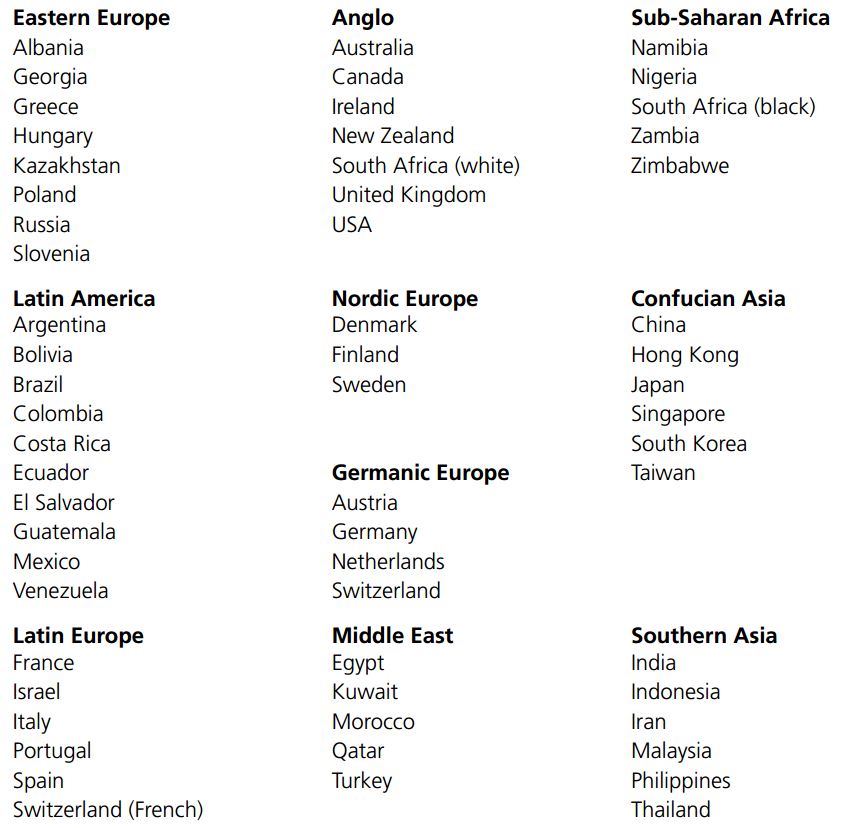
The cultural value dimensions are moderately inter-correlated, and examining differences for a single value dimension without controlling for the others makes it difficult to determine their independent effects on leadership beliefs and behavior. For example, in a country that has high power distance and low uncertainty tolerance, it is not clear how much each value influences the emphasis on centralized decisions for a company. For this reason, researchers have grouped countries into clusters based on regional proximity and similarity in language, ethnic background, and religion (Dorfman et al., 2004; Gupta, Hanges, & Dorfman, 2002).
The GLOBE researchers grouped 60 countries into 10 clusters, and a discriminant analysis confirmed that the classification of countries into clusters accurately reflected differences in the nine cultural values for each country. The nations in each cluster are shown below:
What’s Your Cultural Profile? Use the self-assessment link below to identify your culture profile. Then, comment on your results. Self-Assessment Test by Erin Meyer: https://hbr.org/web/assessment/2014/08/whats-your-cultural-profile ttps://hbr.org/web/assessment/2014/08/whats-your-cultural-profile |
 SELF-CHECK
 Gender and Leadership
Widespread discrimination is clearly evident in the low number of women who hold important, high‐level leadership positions in most types of organizations. The strong tendency to favor men over women in filling high‐level leadership positions has been referred to as the “glass ceiling.” Only a small number of nations have a female head of state (e.g., prime minister, president), and the number of women in top executive positions in large business organizations are also very small, although it has been increasing in recent years. In the complete absence of sex‐based discrimination, the number of women in chief executive positions in business and government should be close to 50 percent.
Theories of Male Advantage vs Theory of Feminine Advantage
Gender-based discrimination was supported by age-old beliefs that men are more qualified than women for leadership roles. These beliefs involved assumptions about the traits and skills required for effective leadership in organizations (implicit theories), assumptions about inherent differences between men and women (gender stereotypes), and assumptions about appropriate behavior for men and women (role expectations). As noted earlier, the implicit theories and gender stereotypes are also influenced by cultural values for gender egalitarianism.
A more recent controversy is fueled by claims that women are more likely than men to possess the values and skills necessary for effective leadership in modern organizations. The difference is a result of childhood experiences, parent-child interactions, and socialization practices that reflect cultural sex‐role stereotypes and beliefs about gender differences and appropriate occupations for men and women.
These experiences encourage “feminine” values such as kindness, compassion, nurturing, and sharing. Proponents of the “feminine advantage” theory contend that women are more concerned with consensus building, inclusiveness, and interpersonal relations; they are more willing to develop and nurture subordinates and share power with them. Women are believed to have more empathy, rely more on intuition, and be more sensitive to feelings and the quality of relationships.
More systematic and comprehensive research is needed to determine the extent of any gender differences in leadership and the reasons for them. It is essential to examine how organizational and cultural factors influence the perceptions and behaviors that shape gender identity.
--------------------------------------------------------------------
Managing Diversity
Diversity can take many forms, including differences in race, ethnic identity, age, gender, education, physical appearance, socioeconomic level, and sexual orientation. More women are entering traditionally male jobs, the number of older workers is increasing, and there is more diversity with regard to ethnic, religious, and racial backgrounds. The increasing number of joint ventures, mergers, and strategic alliances is bringing together people from different types of organizations and national cultures.
READING: The Key to Inclusive Leadership Bourke, J. and Espedido, A. (2020). The key to Inclusive Leadership. Harvard Business Review (Accessed on August 24, 2020: URL: https://hbr.org/2020/03/the-key-to-inclusive-leadership) (Download Pdf) (0 views/downloads) |

A greater variety of perspectives increases creativity, and full utilization of a diverse workforce will increase the amount of available talent for filling important jobs. However, diversity can also result in more distrust and conflict, lower satisfaction, and higher turnover. An organization is less likely to have shared values and strong member commitment when it has many diverse members who identify primarily with their own subgroup. Thus, managing diversity is an important but difficult responsibility of leaders in the twenty‐first century.
1. Do you consider yourself an Inclusive Leader?
2. Do you agree with the results? Reflect and give an example of how you can become an Inclusive Leader. > CLICK HERE TO REFLECT <s://www.catalyst.org/research/quiz-are-you-an-inclusive-leader/ |
Guidelines for Managing Diversity and Promoting Inclusion
Encourage Tolerance & Appreciation
| Discourage Intolerance & Discrimination
|
To make full use of the talent represented by the diverse members of the organization, it is essential to eliminate constraints that prevent qualified people from selection for important positions. Many things can be done to facilitate equal opportunity and reduce discrimination in personnel decisions.
An important responsibility for leaders in this new century is the management of diversity, which can take many forms. Leaders play an essential role in helping to bring about equal opportunity and elimination of unfair discrimination in selection and promotion decisions. Leaders can do many things to encourage tolerance and appreciation of diversity in organizations. All leaders in the organization should share the responsibility for improving diversity and ensuring equal opportunity. Leadership at the national level is also important in the continuing efforts to eliminate unfair discrimination for all minorities and ethnic groups.

No comments:
Post a Comment
Note: Only a member of this blog may post a comment.