SEGMENTATION, TARGETING, AND POSITIONING
OVERVIEW
As small children, we are often taught to treat everyone alike. However, after reading this topic, students will quickly learn that this strategy does not work in marketing. The goal of marketing is to create value and satisfy needs. However, everyone’s needs are not the same. Understanding needs is a complex task.
|
 LESSON:
 After studying this topic, students should be able to:
- Identify the steps in the target marketing process.
- Describe the need for market segmentation and the approaches available to do it.
- Explain how marketers evaluate segments and choose a targeting strategy.
- Discuss how marketers develop and implement a positioning strategy.
SELECT AND ENTER A MARKET
- Understanding people’s needs is an even more complex task today because technological and cultural advances in modern society have created a condition of market fragmentation. This means that people’s diverse interests and backgrounds divide them into numerous groups with distinct needs and wants. Because of this diversity, the same good or service will not appeal to everyone.
- Marketers must balance the efficiency of mass marketing where they serve the same items to everyone, with an effectiveness that comes when they offer each individual exactly what she wants.
- Marketers select a target marketing strategy in which they divide the total market into different segments based on customer characteristics, select one or more segments, and develop products to meet the needs of those specific segments.
SEGMENTATION
Segmentation is the process of dividing a larger market into smaller pieces based on one or more meaningfully shared characteristics. Segmentation is often necessary in both consumer and industrial markets. The marketer must decide on one or more useful segmentation variables—that is, dimensions that divide the total market into homogeneous groups, each with different needs and preferences.
|
Segment Consumer Markets
We can slice the larger consumer “pie” into smaller pieces in a number of ways, including demographic, psychographic, and behavioral differences. In the case of demographic segmentation there are several key sub-categories of demographics: age (including generational differences), gender, family life cycle, income and social class, ethnicity, and place of residence— sometimes referred to separately as geographic segmentation.
|
Demographic Segmentation By Age
- Demographics are statistics that measure observable aspects of a population, including size, age, gender, ethnic group, income, education, occupation, and family structure. These descriptors are vital to identify the best potential customers for a good or service. Because they represent objective characteristics they usually are easy to identify, and then it is just a matter of tailoring messages and products to relevant groups.
- Consumers of different age groups have different needs and wants. Members of a generation tend to share the same outlook and priorities. We call such a focus generational marketing.
- Generation Z. This is the first generation of the 21st century and it’s the most diverse.
- Generation Y, often also called millennials or “Echo Boomers”, consists of people born between the years 1979 and 1994. They are the first generation to grow up online and are more ethnically diverse than earlier generations. Generation Y is an attractive market for a host of consumer products because of its size (approximately 26 percent of the population) and free-spending nature
- The group of consumers born between 1965 and 1978 consists of 46 million Americans known as Generation X. They have developed an identity for being an entrepreneurial group. One study revealed that Xers are already responsible for 70 percent of new start-up businesses in the United States. Many people in this segment seem to be determined to have stable families after being latchkey children themselves. Seven out of ten regularly save some portion of their income, a rate comparable to that of their parents. Xers tend to view the home as an expression of individuality rather than material success.
- Baby boomers, consumers born between 1946 and 1964 and who are now in their 40s, 50s, and 60s are an important segment to many marketers—if for no other reason than that there are so many of them who make a lot of money. Boomers are willing to invest a ton of money, time, and energy to maintain their youthful image.
Demographic Segmentation: By Gender
- Many products, from fragrances to footwear, specifically appeal to men or women. Segmenting by gender starts at a very early age—even diapers come in pink for girls and blue for boys. In some cases, manufacturers develop parallel products to appeal to each sex.
- Metrosexual is a straight, urban male who is keenly interested in fashion, home design, gourmet cooking, and personal care. Metrosexuals are usually well-educated urban dwellers that are in touch with their feminine side.
- An interesting trend related to gender segmentation has been fueled by the recent recession. Men now are increasingly likely to marry wives with more education and income than they have, and the reverse is true for women.
Demographic Segmentation: By Family Life Cycle
- Because family needs and expenditures change over time, one way to segment consumers is to consider the stage of the family life cycle they occupy. Consumers in different life cycle segments are unlikely to need the same products, or at least they may not need these things in the same quantities. As family’s age and move into new life stages, different product categories ascend and descend in importance.
Demographic Segmentation: By Income and Social Class
- The distribution of wealth is of great interest to marketers because it determines which groups have the greatest buying power. Marketers, obviously, are often more interested in high-income consumers. In the past, it was popular for marketers to consider social class segments, such as upper class, lower class, and lower class. However, many consumers buy not according to where they may fall in the schema but rather according to the image they wish to portray.
Demographic Segmentation: By Ethnicity
- A consumer’s national origin is often a strong indicator of his preferences for specific magazines or TV shows, foods, apparel, and choice of leisure activities. Marketers need to be aware of these differences and sensitivities—especially when they invoke outmoded stereotypes to appeal to consumers of diverse races and ethnic groups.
Geographic Segmentation
- Geographic segmentation is an approach in which marketers tailor their offerings to specific geographic areas because people’s preferences often vary depending on where they live. A geographic information system (GIS) is a system that combines a geographic map with digitally stored data about the consumers in a particular geographic area.
- When marketers want to segment regional markets even more precisely, they sometimes combine geography with demographics by using a technique called geodemography. A basic premise of geodemography is that people who live near one another share similar characteristics.
- Geotargeting refers to determining the geographic location of a website visitor and delivering different content to that visitor based on his or her location. Micromarketing is the ability to identify and target very small geographic segments that sometimes amount to individuals.
Segment by Psychographics
- Psychographics is the use of psychological, sociological, and anthropological factors to construct market segments. Psychographics segments consumers in terms of shared activities, interests, and opinions, or AIOs
- VALS™ (Values and Lifestyles) is based on psychological traits that correlate with consumer behavior. VALS™ divides markets into eight groups according to what drives them psychologically as well as by their economic resources.
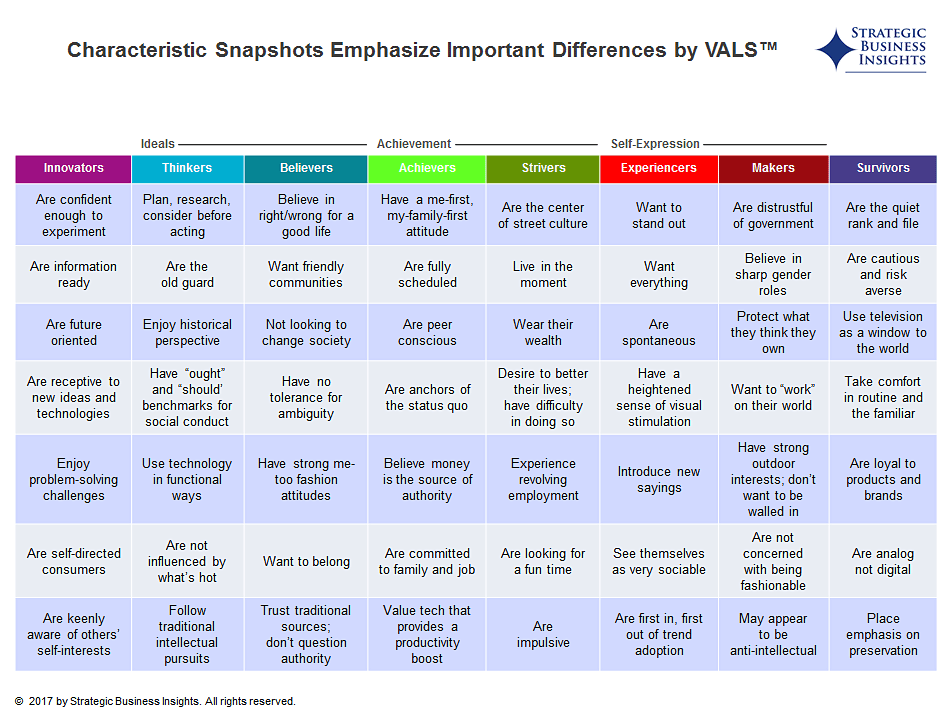
Source: http://www.strategicbusinessinsights.com/vals/ustypes.shtml
- Three primary consumer motivations are key to the system: ideals, achievement, and self-expression. Consumers who are motivated primarily by ideals are guided by knowledge and principles. Consumers who are motivated primarily by achievement look for goods and services that demonstrate success to their peers. In addition, consumers who are motivated primarily by self-expression desire social or physical activity, variety, and risk.
If you go to www.strategicbusinessinsights.com and click on “VALS™ Survey”, you can complete a brief questionnaire free to find out your own VALS™ type (you might be surprised). |
 ACTIVITY
Segment by Behavior
- Behavioral segmentation slices consumers based on how they act toward, feel about, or use a product. One way to segment based on behavior is to divide the market into users and nonusers of a product. In addition to distinguishing between users and nonusers, marketers can describe current customers as heavy, moderate, and light users.
- They often do this according to a rule of thumb we call the 80/20 rule: 20 percent of purchasers account for 80 percent of the product’s sales (the ratio is an approximation, not gospel). This rule means that it often makes more sense to focus on the smaller number of people who are really into a product rather than on the larger number who are just casual users.
- Customer loyalty refers to a customer’s low likelihood of switching to a competitor’s offering, especially because of being highly engaged and connected with their current brand.
- Customer stickiness refers to highly cultivated customers that are likely to follow through on an intended purchase, buy the product repeatedly, and recommend it to others. Experiential loyalty refers to customer loyalty that results not just in increased purchases but also in an enhanced broader experience for the customer.
- An approach called the long tail turns traditional thinking about the virtues of selling in high volume on its head. The basic idea is that we need no longer rely solely on big hits (like blockbuster movies or best-selling books) to find profits. Companies can also make money when they sell small amounts of items that only a few people want—if they sell enough different items.
- Another way to segment a market based on behavior is to look at usage occasions, or when consumers use the product most. We associate many products with specific occasions, whether time of day, holidays, business functions, or casual get-togethers. Businesses often divide their markets according to when and how their offerings are in demand.
TARGETING
The next step is targeting, in which marketers evaluate the attractiveness of each potential segment and decide in which of these groups they will invest resources to try to turn them into customers. The customer group or groups they select are the firm’s target market.
Targeting in Three Steps
The three phases of targeting are: evaluate market segments, develop segment profiles, and choose a targeting strategy.
|
Phase 1: Evaluate Market Segments
Just because a marketer identifies a segment does not necessarily mean that it is a useful one to target. A viable target segment should satisfy the following requirements:
- Are members of the segment similar to each other in their product needs and wants and, at the same time, different from consumers in other segments?
- Can marketers measure the segment?
- Is the segment large enough to be profitable now and in the future?
- Can marketing communications reach the segment?
- Can the marketer adequately serve the needs of the segment?
Phase 2: Develop Segment Profiles
Once a marketer identifies a set of usable segments, it is helpful to generate a profile of each to really understand segment members’ needs and to look for business opportunities. This segment profile is a description of the “typical” customer in that segment. For example, a segment profile includes customer demographics, location, lifestyle information, and a description of how frequently the customer buys the product.
Phase 3: Choose a Targeting Strategy
|
A basic targeting decision is how finely tuned the target should be.
- An undifferentiated targeting strategy is one that appeals to a wide-spectrum of people. If successful, this type of operation can be very efficient, especially because production, research, and promotion costs benefit from economies of scale—it’s cheaper to develop one product or one advertising campaign than to choose several targets and create separate products or messages for each. The company must be willing to bet that people have similar needs or differences among them that are trivial.
- A company that chooses a differentiated targeting strategy develops one or more products for each of several customer groups with different product needs. A differentiated strategy is called for when consumers are choosing among brands that are well known in which each has a distinctive image in the marketplace and in which it is possible to identify one or more segments that have distinct needs for different types of products.
- Differentiated marketing can also involve connecting one product with different segments by communicating differently to appeal to those segments.
- When a firm offers one or more products to a single segment, it uses a concentrated targeting strategy. Smaller firms that do not have the resources or the desire to be all things to all people often do this.
- Ideally, marketers should be able to define segments so precisely that they can offer products and services that exactly meet the unique needs of each individual or firm. A customized marketing strategy is common in industrial contexts in which a manufacturer often works with one or a few large clients and develops products and services that only these clients will use.
- Of course, in most cases this level of segmentation is neither practical nor possible when mass-produced products such as computers or cars enter the picture. However, advances in computer technology, coupled with the new emphasis on building solid relationships with customers, have focused managers’ attention on devising new ways to tailor specific products and the messages about them to individual customers. Thus, some forward-looking, consumer-oriented companies are moving toward mass customization in which they modify a basic good or service to meet the needs of an individual.
STEP 3: POSITIONING
The final stage of developing a target marketing strategy is to provide consumers who belong to a targeted market segment with a good or service that meets their unique needs and expectations. Positioning means developing a marketing strategy to influence how a particular market segment perceives a good or service in comparison to the competition. To position a brand, marketers have to clearly understand the criteria target consumers use to evaluate competing products and then convince them that their product, service or organization will meet those needs.
|
Steps in Positioning
Marketers use four steps to decide just how to position their product or service:
Step 1: Analyze Competitors’ Positions
The first stage is to analyze competitors’ positions in the marketplace. To develop an effective positioning strategy, marketers must understand the current lay of the land.
Step 2: Define Your Competitive Advantage
The second stage is to offer a good or service with a competitive advantage to provide a reason to perceive the product as better than the competition’s. A positioning statement can frame how a product is positioned so that marketing communication remains focused on articulating the specific value offered.
Step 3: Finalize the Marketing Mix
Once they settle on a positioning strategy, the third stage is to finalize the marketing mix as they put all the pieces into place. The elements of the marketing mix must match the selected segment. The good or service must deliver benefits that the segment values, such as convenience or status.
Step 4: Evaluate Responses and Modify as Needed
In the fourth and final stage, marketers evaluate the target market’s responses so they can modify strategies. The firm may need to change which segments it targets or alter a product’s position to respond to marketplace changes.
A change strategy is repositioning, and it is common to see a company try to modify its brand image to keep up with changing times. Repositioning also occurs when a marketer revises a brand thought to be dead or at least near death. Sometimes these products arise from their deathbeds to ride a wave of nostalgia and return to the marketplace as retro brands—venerable brands like Oxydol laundry detergent, Breck Shampoo, Ovaltine cereal, and Tab cola have gotten a new lease on life in recent years
Perceptual Maps
- One solution is to ask consumers what characteristics are important and how competing alternatives would rate on these attributes, too. Marketers use this information to construct a perceptual map, which is a vivid way to construct a picture of where products or brands are “located” in consumers’ minds.
- Perceptual mapping allows marketers to identify consumers’ perceptions of their brand in relation to the competition.
- A neglected segment is an unserved or underserved market segment for which opportunity may exist for new product entry.
>POST YOUR PERCEPTUAL MAP HERE< |

No comments:
Post a Comment
Note: Only a member of this blog may post a comment.