Showing posts with label academic. Show all posts

Tuesday, December 23, 2025

Management Series: Is Leadership Behaviour Important?

 Leadership Behaviour


After studying this topic, you should be able to:

  • Explain the major types of leader behavior in leadership theory and research.
  • Discuss why task and relations behaviors are both important for leadership.
  • Examine how specific types of tasks and relations behaviors can be used effectively.


Types of Leadership Behavior

Most theories and research on effective leadership behavior involve one or two broadly defined behaviors (sometimes called meta-categories ). This section of the topic briefly describes several meta-categories that are relevant for effective leadership, and they are explained in more detail later in this chapter and other topics.


Task and Relations Behaviors

  • Much of the early theory and research on effective leadership behavior was strongly influenced by work at Ohio State University during the 1950s. The initial task of the researchers was to identify categories of relevant leadership behavior and develop questionnaires to measure how often a leader used these behaviors. A preliminary questionnaire was used by samples of military and civilian personnel to describe the behavior of their supervisors (Fleishman, 1953; Halpin & Winer, 1957; Hemphill & Coons, 1957). Analysis of the questionnaire responses indicated that subordinates perceived their supervisor’s behavior primarily in terms of two broadly defined meta-categories.
  • One set of behaviors involves concern for relationships and was labeled consideration . This behavior category included doing personal favors for subordinates, finding time to listen to a subordinate with a problem, backing up or defending a subordinate, consulting with subordinates on important matters, being willing to accept suggestions from subordinates, and treating a subordinate as an equal.
  • The other set of behaviors was involved concern for task objectives and was labeled initiating structure . This behavior category included assigning tasks to subordinates, maintaining definite standards of performance, asking subordinates to follow standard procedures, emphasizing the importance of meeting deadlines, criticizing poor work, and coordinating the activities of different subordinates.
  • Other researchers also developed questionnaires with scales for task and relations behaviors, although the labels and component behaviors varied somewhat from version to version. It was widely accepted that leaders must use some task and relations behaviors to be effective, and these two meta-categories influenced most of the early leadership theories.

Task-Oriented

Relations-Oriented

Source

Initiating Structure

Consideration

Fleishman (1953); Halpin & Winer (1957)

Concern for Production

Concern for People

Blake & Mouton (1964)

Instrumental Leadership

Supportive Leadership

House (1971)

Goal Emphasis; Work

Supportive Leadership

Bowers & Seashore (1966);

Facilitation

Interaction Facilitation

Taylor & Bowers (1972)

Performance Behavior

Maintenance Behavior

Misumi & Peterson (1985)


Change-oriented behavior

The early leadership theory and research paid little attention to behaviors directly concerned with encouraging and facilitating change. In the 1980s, some change-oriented behaviors were included in theories of charismatic and transformational leadership, but leading change was still not explicitly recognized as a separate dimension or meta category. Evidence for the construct validity of change-oriented meta-category was later found by researchers in Sweden and the United States (Ekvall & Arvonen, 1991; Yukl, 1997, 1999a; Yukl, Gordon, & Taber, 2002).

Some specific types of leader behavior in a meta-category affect only one objective, but other types of behavior affect more than one objective. For example, when a leader consults with team members about the action plan for a project, the result may be more commitment to the project (human relations), better use of available personnel and resources (task efficiency), and discovery of more innovative ways to satisfy the client (adaptation). When a leader provides coaching for an employee, the result may be improved productivity (task efficiency), an increase in employee skills relevant for career advancement (human relations), and better implementation of an innovative new program (adaptive change).


Participative Leadership

Another behavior category identified in the early leadership research is participative leadership , which is also called empowering leadership and democratic leadership . It involves a leader’s use of decision procedures that allow other people such as subordinates to have some influence over decisions that will affect them (Coch & French, 1948; Heller & Yukl, 1969; Likert, 1961, 1967; Vroom & Yetton, 1973). The use of empowering decision procedures reflects a strong concern for relations objectives such as subordinate commitment and development, but it can also involve a concern for task objectives such as decision quality. The content of leader decisions may involve task objectives (plan work procedures), relations objectives (determine how to improve employee benefits), change objectives (identify innovative new initiatives), or some combination of the three types of objectives. Participative decision procedures such as consultation or a joint decision can be used with peers and outsiders (e.g., suppliers, clients) as well as with subordinates.


Transformational Leadership

Another behavior meta-category that was identified in the 1980s is usually called transformational leadership (Bass, 1985), but other terms for it include visionary leadership and inspirational leadership . The component behaviors vary for different theories and measures of transformational leadership, but they usually include a few relations-oriented behaviors such as supporting and developing, a few change-oriented behaviors such as articulating an appealing vision and encouraging innovative thinking, and a few behaviors that are difficult to classify into a single meta-category (e.g., leading by example, talking about personal values, making self-sacrifices for the team or organization). Some of the same behaviors are also described in theories of charismatic leadership .


External Leadership Behaviors

Theories and research on dyadic leadership seldom include boundary-spanning behaviors, in part because information about a leader’s behavior is typically obtained only by surveying subordinates who have little opportunity to observe how their leader interacts with people outside the work unit or organization. 

Three distinct and broadly defined categories of external behavior are networking, environmental scanning, and representing (Luthans & Lockwood, 1984; Stogdill, Goode, & Day, 1962; Yukl et al., 2002; Yukl & Van Fleet, 1982; Yukl, Wall, & Lepsinger, 1990).

  • Networking involves building and maintaining favorable relationships with peers, superiors, and outsiders who can provide desired information, resources, and political support. The behavior category includes attending professional conferences and ceremonies, joining social networks, socializing informally, doing favors, and using impression management tactics such as ingratiation.
  • Environmental scanning (also called external monitoring ) includes collecting information about relevant events and changes in the external environment, identifying threats and opportunities for the leader’s group or organization, and identifying best practices that can be imitated or adapted. The scanning may be carried out by using a leader’s network of contacts, by studying relevant publications and industry reports, by conducting market research, and by studying the decisions and actions of competitors and opponents.
  • Representing includes lobbying for resources and assistance from superiors, promoting and defending the reputation of the leader’s group or organization, negotiating agreements with peers and outsiders such as clients and suppliers, and using political tactics to influence decisions made by superiors or governmental agencies. The proactive influence tactics described in are commonly used for lobbying and negotiating.

----------------------------------------------------------------- Top ^

task

Exercise

FIND AN EFFECTIVE LEADER

leaders

Identify someone you think is an effective leader. What makes him or her effective?

> POST YOUR REFLECTION NOW <


Evaluation of the Behavior Research

Much of the behavior research suffers from the tendency to look for simple answers to complex questions, and it is not surprising that meta-analyses of survey studies find only weak positive relationships between effective leadership and meta-categories such as task and relations behavior. Behavior taxonomies are descriptive aids that can help us to analyze complex events and understand them better. Broadly-defined categories can be useful for comparing results from different studies, but there has been too much reliance on them in the formulation of theory and design of research. In most survey studies, the researchers failed to consider whether some specific component behaviors are more relevant than others for the leadership situation, or how the relevance of a specific behavior varies across different situations.

In a theory called the managerial grid, Blake and Mouton (1964, 1982) proposed that effective managers have a high concern for people and a high concern for production. These concerns are defined as values rather than as behaviors. High concern for both people and production (the “high-high leader”) does not imply that the leader must use all forms of task and relations behavior. effective managers will only use specific behaviors that are relevant to their situation.
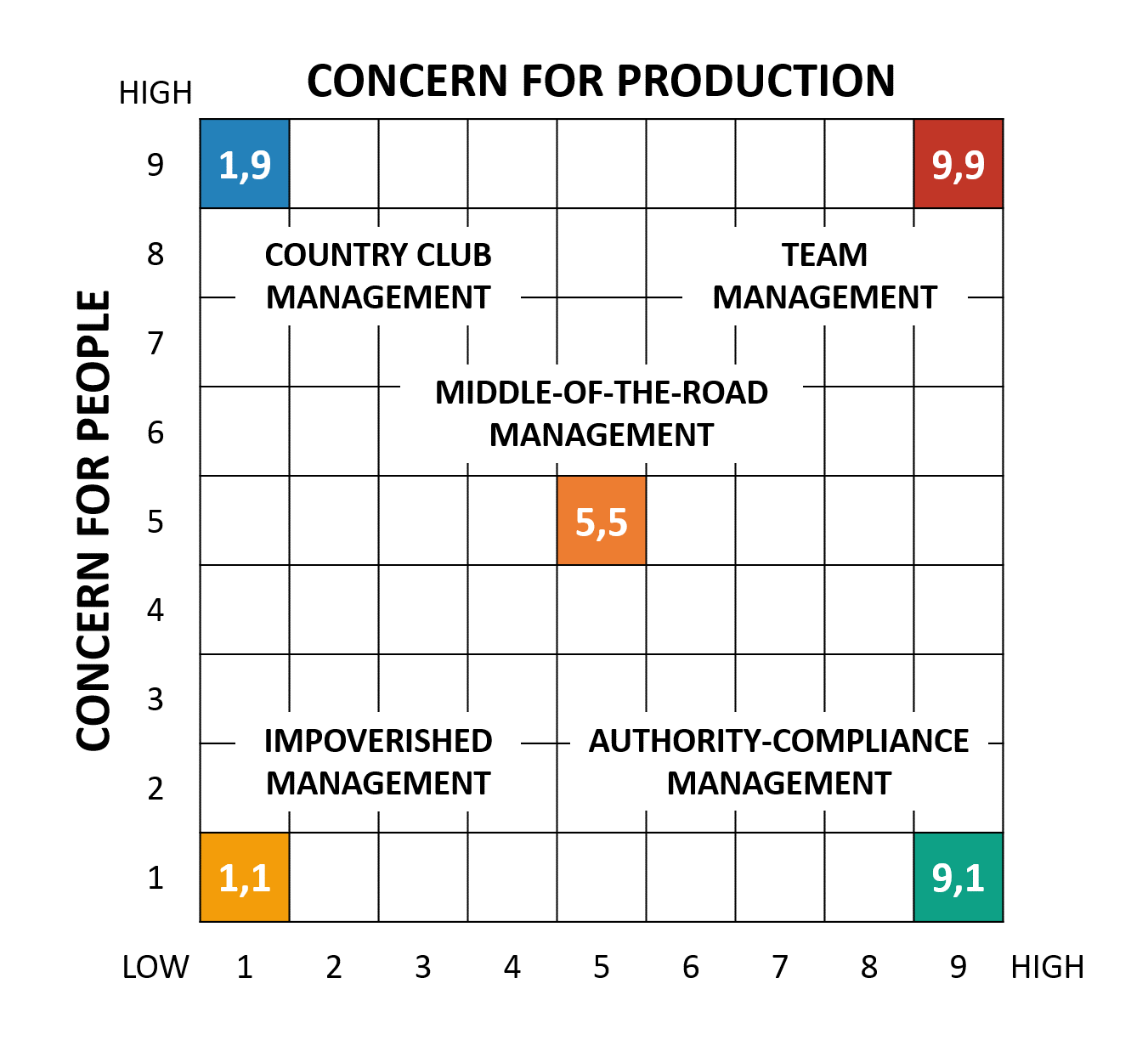
Blake-and-Mouton-Managerial-Grid

Blake and Mouton Managerial Grid

Source: https://www.business-to-you.com/blake-mouton-managerial-grid/ 

Aspects of the situation that determine which task-oriented and relations-oriented behaviors are most relevant include the type of team or organization, the nature of the task, and characteristics of subordinates (e.g., experience, motives, gender and cultural diversity, trust and loyalty, identification with the team).

-----------------------------------------------------------------


Guidelines for using the Behavior Effectively

In the remainder of this topic, specific types of task and relations behavior are explained and guidelines provided for using the behaviors effectively in most situations where they are relevant. The guidelines are based on applied research in leadership, on suggestions by practitioners, and on relevant theory and research in the management literature (e.g., project management, operations management, performance management, and human resources
management).


Specific Tasks-Oriented Leader Behaviors

Planning Work Activities

Planning is mostly a cognitive activity involving the processing of information, analyzing, and deciding. Planning seldom occurs in a single behavior episode; instead, it tends to be a prolonged process that occurs over a period of weeks or months. 

For example, making decisions about objectives, priorities, strategies, organization of the work, assignment of responsibilities, scheduling of activities, and allocation of resources among different activities according to their relative importance

Guidelines for Action Planning

  • Identify the necessary action steps.
  • Identify the optimal sequence of action steps.
  • Estimate the time needed to carry out each action step.
  • Determine starting times and deadlines for each action step.
  • Estimate the cost of each action step.
  • Determine who will be accountable for each action step.
  • Develop procedures for monitoring progress.


Clarifying Roles and Objectives

Clarifying is the communication of plans, policies, and role expectations. Major subcategories of clarifying include (1) defining job responsibilities and requirements, (2) setting performance goals, and (3) assigning specific tasks. The purpose of clarifying behavior is to guide and coordinate work activity and make sure people know what to do and how to do it. It is essential for each subordinate to understand what duties, functions, and activities are required in the job and what results are expected. Even a subordinate who is highly competent and motivated may fail to achieve a high level of performance if confused about responsibilities and priorities. Such confusion results in misdirected effort and neglect of important responsibilities in favour of less important ones. The more complex and multifaceted the job, the more difficult it is to determine what needs to be done.

Guidelines for Clarifying Roles and Objectives

  • Clearly explain an assignment
  • Explain the reason for the assignment
  • Check for understanding of the assignment
  • Provide any necessary instruction on how to do the task
  • Explain priorities for different objectives or responsibilities
  • Set specific goals and deadlines for important tasks


Monitoring Operations and Performance

Monitoring involves gathering information about the operations of the manager’s organizational unit, including the progress of the work, the performance of individual subordinates, the quality of products or services, and the success of projects or programs. Monitoring can take many forms, including observation of work operations, reading written reports, watching computer screen displays of performance data, inspecting the quality of samples of the work, and holding progress review meetings with an individual or group. Many organizations use video cameras to observe operations and increase security, and monitoring of telephone calls and internet correspondence is commonly used to check on quality for customer service representatives. To assess performance for retail facilities and service centers, it is sometimes useful to have somebody disguised as a customer visit them to observe how well the employees provide customer service. The appropriate type of monitoring depends on the nature of the task and other aspects of the situation.

Guidelines for Monitoring Operations

  • Identify and measure key performance indicators.
  • Monitor key process variables as well as outcomes.
  • Measure progress against plans and budgets.
  • Develop independent sources of information about the performance
  • Conduct progress review meetings at appropriate times.
  • Observe operations directly when it is feasible.
  • Ask specific questions about the work.
  • Encourage reporting of problems and mistakes.
  • Use information from monitoring to guide other behaviors

Guidelines for Solving Operational Problems

  • Anticipate operational problems and prepare for them.
  • Learn to recognize early warning signs for an impending problem.
  • Quickly identify the cause and scope of the problem.
  • Look for connections among problems.
  • Direct the response to the problem in a confident and decisive way.
  • Keep people informed about the problem and what is being done to resolve it.
  • Be willing to explore innovative solutions


Specific Relations-Oriented Leader Behaviors

Supportive leadership

Supportive leadership (or “supporting”) includes a wide variety of behaviors that show consideration, acceptance, and concern for the needs and feelings of other people. Supportive leadership helps to build and maintain effective interpersonal relationships. A manager who is considerate and friendly toward people is more likely to win their friendship and loyalty. The emotional ties that are formed make it easier to gain cooperation and support from people on whom the manager must rely to get the work done. It is more satisfying to work with someone who is friendly, cooperative, and supportive than with someone who is cold and impersonal, or worse, hostile, and uncooperative. Improvements in job satisfaction are likely to result in less absenteeism, less turnover, less alcoholism, and less drug abuse (Brief, Schuler, & Van Sell, 1981; Ganster, Fusilier, & Mayes, 1986; Kessler, Price, & Wortman, 1985). Supportive leadership may increase a subordinate’s acceptance of the leader, trust of the leader, and willingness to do extra things for the leader. It includes:

Guidelines for Supporting

  • Show acceptance and positive regard.
  • Show interest in the person as an individual
  • Provide sympathy and support when the person is anxious or upset.
  • Bolster the person’s self-esteem and confidence.
  • Be willing to help with personal problems.

idea2 INSIGHTS

3173

Oprah Winfrey, founder of Oprah Winfrey Network, is an employee-oriented leader. Her compassionate and nurturing behavior towards subordinates helps them realize their full potential, inspires them to succeed, and results in their loyalty and job satisfaction. Caring for her employees has contributed to Oprah’s success as an entrepreneur and business leader


Developing Subordinate Skills

Developing includes several managerial practices that are used to increase a subordinate’s skills and facilitate job adjustment and career advancement. Key component behaviors include mentoring, coaching, and providing developmental opportunities. Developing is usually done with a subordinate, but it may also be done with a peer, a colleague, or even with a new, inexperienced boss. Responsibility for developing subordinates can be shared with other members of the work unit who are competent and experienced. For example, some leaders assign an experienced subordinate to serve as a mentor and coach for a new employee. 

Guidelines for Developing Subordinates

  • Show concern for each person’s development.
  • Help the person identify ways to improve performance.
  • Be patient and helpful when providing coaching.
  • Provide helpful career advice.
  • Help the person prepare for a job change.
  • Encourage attendance at relevant training activities.
  • Provide opportunities to learn from experience.
  • Encourage coaching by peers when appropriate.
  • Promote a person’s reputation.


Providing Praise and Recognition

Recognizing involves giving praise and showing appreciation to others for effective performance, significant achievements, and important contributions to the organization. Although it is most common to think of recognition as being given by a manager to subordinates, this managerial practice can also be used with peers, superiors, and people outside the work unit. The primary purpose of recognizing, especially when used with subordinates, is to strengthen desirable behavior and task commitment. Recognizing is primarily a relations behavior, but like developing, it can contribute to the attainment of task objectives as well.

  • Three major forms of recognizing are praise, awards, and recognition ceremonies. Praise consists of oral comments, expressions, or gestures that acknowledge a person’s accomplishments and contributions. It is the easiest form of recognition, but it is under-utilized by many managers.
  • Awards include things such as a certificate of achievement, a letter of commendation, a plaque, a trophy, a medal, or a ribbon. Awards can be announced in many different ways, including an article in the company newsletter, a notice posted on the bulletin board, a picture of the person (e.g., “employee of the month”) hung in a prominent place, over a public address system, in regular meetings, and at special ceremonies or rituals.
  • A recognition ceremony ensures that an individual’s achievements are acknowledged not only by the manager but also by other members of the organization. Recognition ceremonies can be used to celebrate the achievement of a team or work unit as well as those of an individual.

Guidelines for Developing Subordinates

  • Show concern for each person’s development.
  • Help the person identify ways to improve performance.
  • Be patient and helpful when providing coaching.
  • Provide helpful career advice.
  • Help the person prepare for a job change.
  • Encourage attendance at relevant training activities.
  • Provide opportunities to learn from experience.
  • Encourage coaching by peers when appropriate.
  • Promote a person’s reputation.


task

Exercise

PEOPLE-ORIENTED or TASK-ORIENTED?

Think of specific situations in which it might be especially important for a manager to engage in
'consideration' and in 'initiating structure'.

> POST YOUR ANSWER HERE <

Management Series: Introduction to Leadership

 Topic 1: Introduction

Learning Outcomes:

After studying this topic you should be able to:

1.1 Examine the different ways leadership has been defined.

1.2 Discuss the major types of leadership theories that have been studied.

1.3 Analyse the different ways leadership effectiveness is determined.

1.4 Explain what aspects of leadership have been studied the most.


reflectOpening Vignette

log in the water

African proverb: a log can lie in water for 10 years and it still won’t be a crocodile.  You can have the title of “leader” or “manager” for many years but you won’t be a leader or manager unless you understand people.

Agree or Disagree?

> CLICK HERE TO POST YOUR REFLECTION<


Introduction to Leadership

Leadership is a subject that has long excited interest among people. The term connotes images of powerful, dynamic individuals who command victorious armies, direct corporate empires from atop gleaming skyscrapers or shape the course of nations. The exploits of brave and clever leaders are the essence of many legends and myths. Much of our description of history is the story of military, political, religious, and social leaders who are credited or blamed for important historical events, even though we do not understand very well how the events were caused or how much influence the leader really had. The widespread fascination with leadership maybe because it is such a mysterious process, as well as one that touches everyone’s life.


idea Reflection

  • Why did certain leaders (e.g., Gandhi, Mohammed, Mao Tse-tung) inspire such intense fervour and dedication?
  • How did certain leaders (e.g., Julius Caesar, Alexander the Great) build great empires?
  • Why did some rather undistinguished people (e.g., Adolf Hitler, Claudius Caesar) rise to positions of great power?
  • Why were certain leaders (e.g., Winston Churchill, Indira Gandhi) suddenly deposed, despite their apparent power and record of successful accomplishments?
  • Why do some leaders have loyal followers who are willing to sacrifice their lives, whereas other leaders are so despised that subordinates conspire to murder them?


Questions about leadership have long been a subject of speculation, but scientific research on leadership did not begin until the twentieth century. The focus of much of the research has been on the determinants of leadership effectiveness. Social scientists have attempted to discover what traits, abilities, behaviours, sources of power, or aspects of the situation determine how well a leader is able to influence followers and accomplish task objectives. There is also a growing interest in understanding leadership as a shared process in a team or organization and the reasons why this process is effective or ineffective. Other important questions include the reasons why some people emerge as leaders and the determinants of a leader’s actions, but the predominant concern has been leadership effectiveness.


Definitions of Leadership

The term leadership is a word taken from the common vocabulary and incorporated into the technical vocabulary of a scientific discipline without being precisely redefined. As a consequence, it carries extraneous connotations that create ambiguity of meaning. Researchers usually define leadership according to their individual perspectives and the aspects of the phenomenon of most interest to them. After a comprehensive review of the leadership literature, Stogdill (1974, p. 259) concluded that “there are almost as many definitions of leadership as there are persons who have attempted to define the concept.” The stream of new definitions has continued unabated since Stogdill made his observation. Leadership has been defined in terms of traits, behaviors, influence, interaction patterns, role relationships, and occupation of an administrative position.


Warren-G.-Bennis-The-Father-of-Leadership-Tribute

“Becoming a leader is synonymous with becoming yourself. It is precisely that simple, and it is also that difficult”

“Always, it seems, the concept of leadership eludes us or turns up in another form to taunt us again with its slipperiness and complexity. So we have invented an endless proliferation of terms to deal with it…and still the concept is not sufficiently defined.”
-Bennis (1959)


Most definitions of leadership reflect the assumption that it involves a process whereby intentional influence is exerted over other people to guide, structure, and facilitate activities and relationships in a group or organization. The numerous definitions of leadership appear to have little else in common. They differ in many respects, including who exerts influence, the intended purpose of the influence, the manner in which influence is exerted, and the outcome of the influence attempt. The differences are not just a case of scholarly nit-picking; they reflect deep disagreement about the identification of leaders and leadership processes. Researchers who differ in their conception of leadership select different phenomena to investigate and interpret the results in different ways. Researchers who have a very narrow definition of leadership are less likely to discover things that are unrelated to or inconsistent with their initial assumptions about effective leadership.


Definitions of Leadership presented Over the past 50 years:

  • Leadership is “the behavior of an individual . . . directing the activities of a group toward a shared goal” (Hemphill & Coons, 1957, p. 7).
  • Leadership is “the influential increment over and above mechanical compliance with the routine directives of the organization” (Katz & Kahn, 1978, p. 528).
  • Leadership is “the process of influencing the activities of an organized group toward goal achievement” (Rauch & Behling, 1984, p. 46).
  • “Leadership is about articulating visions, embodying values, and creating the environment within which things can be accomplished” (Richards & Engle, 1986, p. 206).
  • “Leadership is a process of giving purpose (meaningful direction) to collective effort, and causing willing effort to be expended to achieve purpose” (Jacobs & Jaques, 1990, p. 281).
  • Leadership “is the ability to step outside the culture . . . to start evolutionary change processes that are more adaptive” (Schein, 1992, p. 2).
  • “Leadership is the process of making sense of what people are doing together so that people will understand and be committed” (Drath & Palus, 1994, p. 4).
  • Leadership is “the ability of an individual to influence, motivate, and enable others to contribute toward the effectiveness and success of the organization . . .” (House et al., 1999, p. 184).
  • “Leadership is a formal or informal contextually rooted and goal-influencing process that occurs between a leader and a follower, groups, of followers, or institutions” (Antonakis & Day, 2018, p. 5).


In this course, leadership is defined broadly in a way that takes into account several things that determine the success of a collective effort by members of a group or organization to accomplish meaningful tasks. The following definition is used:

"Leadership is the process of influencing others to understand and agree about what needs to be done and how to do it, and the process of facilitating individual and collective efforts to accomplish shared objectives." (Yulk & Gardner, 2020)


taskEXERCISE: LEADERSHIP DEFINITION

Based on your own opinion, which definition do you think best describe leadership? Why?

> CLICK HERE TO POST YOUR ANSWER <


-------------------------------------------------------------------------

Leadership or Management

There is a continuing controversy about the difference between leadership and management. It is obvious that a person can be a leader without being a manager (e.g., an informal leader), and a person can be a manager without leading. Indeed, some people with the job title “manager” do not have any subordinates (e.g., a manager of financial accounts). Nobody has proposed that managing and leading are equivalent, but the degree of overlap is a point of sharp disagreement.

Managers value stability, order, and efficiency, and they are impersonal, risk-averse, and focused on short-term results. Leaders value flexibility, innovation, and adaptation; they care about people as well as economic outcomes, and they have a longer-term perspective with regard to objectives and strategies. Managers are concerned about how things get done, and they try to get people to perform better. Leaders are concerned with what things mean to people, and they try to get people to agree about the most important things to be done.

Leaders and followers influence each other as they interact in non-coercive ways to decide what changes they want to make. Managers may be leaders, but only if they have this type of influence relationship.

Defining managing and leading as distinct roles, processes, or relationships may obscure more than it reveals if it encourages simplistic theories about effective leadership. Most scholars seem to agree that success as a manager or administrator in modern organizations also involves leading.

There are a wide variety of ways leaders can influence the effectiveness of a group or organization:

  • The choice of objectives and strategies to pursue.
  • The motivation of members to achieve the objectives.
  • The mutual trust and cooperation of members.
  • The organization and coordination of work activities.
  • The allocation of resources to activities and objectives.
  • The development of member skills and confidence.
  • The learning and sharing of new knowledge by members.
  • The enlistment of support and cooperation from outsiders.
  • The design of the formal structure, programs, and systems.
  • The shared beliefs and values of members.

movieLearn from Video: Why leadership is a choice?

HOW TO BE A LEADER - Motivational Speech By Simon Sinek

Source: REDDOT X

-------------------------------------------------------------------------


Indicators of Leadership Effectiveness

Most researchers evaluate leadership effectiveness in terms of the consequences of influence on a single individual, a team or group, or an organization. One very relevant indicator of leadership effectiveness is the extent to which the performance of the team or organization is enhanced and the attainment of goals is facilitated (Bass, 2008; Kaiser, Hogan & Craig, 2008). Examples of objective measures of performance include sales, net profits, profit margin, market share, return on investment, return on assets, productivity, cost per unit of output, costs in relation to budgeted expenditures, and change in the value of the corporate stock. Subjective measures of effectiveness include ratings obtained from the leader’s superiors, peers, or subordinates.

Indicators

Leader effectiveness is occasionally measured in terms of the leader’s contribution to the quality of group processes, as perceived by followers or by outside observers. Does the leader enhance group cohesiveness, member cooperation, member commitment, and member confidence that the group can achieve its objectives? Does the leader enhance problem-solving and decision making by the group, and help to resolve disagreements and conflicts in a constructive way? Does the leader contribute to the efficiency of role specialization, the organization of activities, the accumulation of resources, and the readiness of the group to deal with change and crises?


What Criteria to Use?

There is no simple answer to the question of how to evaluate leadership effectiveness. The selection of appropriate criteria depends on the objectives and values of the person making the evaluation, and people have different values. For example, top management may prefer different criteria than other employees, customers, or shareholders. To cope with the problems of incompatible criteria, delayed effects, and the preferences of different stakeholders, it is usually best to include a variety of criteria in research on leadership effectiveness and to examine the impact of the leader on each criterion over an extended period of time. Multiple conceptions of effectiveness, like multiple conceptions of leadership, serve to broaden our perspective and enlarge the scope of inquiry.

-------------------------------------------------------------------------

taskEXERCISE

You are the CEO of a medium-size company that makes window coverings. Your company has a real cost advantage in terms of being able to make custom window coverings at costs that are relatively low in the industry. However, the performance of your company has been lackluster. To make needed changes and improve performance, you met with the eight other top managers in your company and charged them with identifying problems and missed opportunities in each of their areas and coming up with an action plan to address the problems and take advantage of opportunities. Once you gave the managers the okay, they were charged with implementing their action plans in a timely fashion and monitoring the effects of their initiatives monthly for the next 8 to 12 months.

You approved each of the managers’ action plans, and a year later most of the managers were reporting that their initiatives had been successful in addressing the problems and opportunities they had identified a year ago. However, overall company performance continues to be lackluster and shows no signs of improvement.

You are confused and starting to question your leadership capabilities and approach to change. What are you going to do to improve the performance and effectiveness of your company?


> CLICK HERE TO POST YOUR ANSWER <

Management Series: Perception and Decision Making in Business

 PERCEPTION & DECISION MAKING 

Learning Outcomes:

  1. Explain the factors that influence perception.
  2. Describe attribution theory.
  3. Explain the link between perception and decision-making.
  4. Explain how individual differences and organizational constraints affect decision-making.

The old saying is that “perception is reality” and managers must learn what “reality” their workers are reacting to in order to effectively predict behavior.  This topic examines how perception acts to create an employee’s view of reality and modifies decision-making. 


WHAT IS PERCEPTION?

Perception is a process by which individuals organize and interpret their sensory impressions in order to give meaning to their environment. However, what we perceive can be substantially different from objective reality. For example, all employees in a firm may view it as a great place to work—favorable working conditions, interesting job assignments, good pay, excellent benefits, understanding and responsible management—but, as most of us know, it’s very unusual to find such agreement. 

The study of perception is important simply because people’s behavior is based on their perceptions of what reality is, not on reality itself. The world as it is perceived is the world that is behaviorally important. OB is concerned with “people perception” because how people see each other can, in large part, determine how well these individuals can work together and indicate an organization’s level of potential conflict. 


Attribution Theory

The attribution theory helps us to understand our perceptions about others.  Research has shown that our perceptions about others are based upon the assumptions we make about them.  The attribution theory says that when we observe behavior we try to determine if it is internally or externally driven.  If it is internally driven it is under the person’s control whereas external causes are not under the individual’s control.   

We can use three factors to help us decide if behavior is internally or externally controlled:  distinctiveness, consensus, consistency.  Distinctiveness shows different behaviors in different situations.  Consensus looks at the response and compares it to others in the same situation to see if it is consistent with the behaviors of others.  Consistency looks to see if the response is the same over time.


Attribution Errors

There are errors and biases in the attributions we make.  First, we often tend to underestimate the influence of external factors and overestimate the influence of internal factors.  This is called the fundamental attribution error.

The next common error is the self-serving bias.  This bias exists when individuals attribute their own successes to internal factors and blame external factors when they don’t have success.

There are some frequently used shortcuts in judging others.  People will utilize past experience, their attitudes and their interests to interpret information on their own biases, often misperceiving the situation - Selective Perception 

Judgment can also utilize the halo effect where they will draw generally favorable impressions about an individual with a single characteristic is positive.  The opposite is true when they draw unfavorable impressions about an individual based on a single negative characteristic, this is called the horn effect.

Contrast effects occur when we are making judgments about an individual and comparing them to other individuals we have recently encountered. 

Stereotyping is when we judge someone on the basis of the perception of the group to which he or she belongs.  

-----------------------------------------------------------------------

 reflect

   TUTORIAL ACTIVITY


  • Using your favorite search engine, enter the term “famous perceptual experiments” and select ONE (1) that look interesting to you.
  • Based on your own opinion, describe what impact these studies have on organizational behavior.

The Link Between Perception and Decision Making

In organisational behaviour, we are concerned with how decisions are made and perceptions play a significant role in that process.  Often decision-making occurs as a reaction to a problem or a perceived discrepancy between the way things are and the way we would like them to be.  A decision is then made based on various alternatives that have been developed from the data collected.  Perception influences this entire process from problem recognition to data selection to alternatives chosen.

Decision-making is done by individuals but occurs in organizations.  There are some models that can help us in thinking through decision-making in organizations.  The first is the Rational decision-making model. The steps are outlined in this slide.  Although this is a good model it is more of a goal than a practical method. This is because the model assumes a perfect world in order to make decisions.  It assumes that there is complete information, that every option has been identified and that there is a maximum payoff.

The second, bounded reality, represents more of the real world where it seeks solutions that are the best given the information that is available.  Basically bounded rationality constructs simplified models that identify the essential features of problems without getting into all their complexity.

The third model is based on intuition - Intuitive Decision Making.  This is the non-conscious process that occurs from experiences that result in quick decisions. Most of the time, decisions were made based on gut feeling.

Common Biases and Errors

Business leaders are well aware that decision-making is immensely difficult to get right. They engage in bounded rationality, but they also allow systematic biases and errors to creep into their judgments. There are many biases and errors that occur in the decision-making process:

  • Overconfidence Bias
    Individuals overestimate or have excessive confidence in their ability to predict or foresee future events. This will cause the decision maker to unsupported or risky decisions.
  • Hindsight Bias
    This is the tendency of individuals to see past mistakes or occurrences as obvious. After the event has occurred, individuals believe that they did or should have seen it coming. This is important when evaluating others' decisions.
  • Anchoring Effect
    Anchoring is when someone attaches themselves to an initial bit of information. In decision-making, it entails people placing too much emphasis on a single piece of information. This can cause the decision maker to fail to consider other important information.
  • Framing Bias
    Framing bias is an individual's response to how a situation or decision is presented. This can lead to individuals being deceived or manipulated by third parties.
  • Escalation of Commitment
    This is a tendency of individuals to continue to follow what has proven to be a negative or unproductive course of action. Also known as the sunk cost fallacy or sunk cost bias, because the tendency is motivated by an unwillingness to admit that they are wrong or accept that resources are lost or wasted (they may be able to recover the investment).
  • Immediate Gratification
    This is the tendency to make the immediacy of a potential solution to a problem or situation the most important criterion. The result is the failure to consider all available options and settling for a sub-part outcome from a decision that fails to deliver all available value.
  • Selective Perception
    This is the tendency to see a particular situation or issue from a chosen perspective. This is related to the team-based mentality. We see all situations or issues through a common lens that influences our ability to understand alternative or conflicting points of view or alternatives.
  • Confirmation Bias
    Confirmation bias is actively looking for information or facts in a situation that supports a particular choice or decision. This approach causes the decision maker to ignore evidence to the contrary. This can also cause a failure to consider contrary information of positions.
  • Availability Bias
    Availability bias is a focus on immediate information or situations that come to one's mind. The result is that we tend to believe the information or experience that we recall or demonstrative or explicative of a situation or scenario. This comes at the expense of looking for additional information that could lead to a further understanding of the situation. As such, a decision is made on limited or superficial information.
  • Self-Serving Bias
    This is one's tendency to attribute the positive results of a decision or situation to one's own actions or decisions. Likewise, it causes individuals to attribute negative consequences to factors outside of their control. This can cause an inability to accurately assess or affect a situation through decision-making.
  • Commitment Errors
    This is an increased commitment to a previous decision in spite of negative information. A business owner may put some money down on a storefront location to rent DVDs and Blu-rays, start purchasing stock for his or her shelves and hire a few people to help him or her watch the cash register. The owner may review some data and stats that indicate people don’t go out and rent videos too much anymore, but, because he or she is committed to the location, the stock, the people, the owner is going to continue down that path and open a movie rental location.

    Managers sometimes want to prove their initial decision was correct by letting a bad decision go on too long, hoping the direction will be corrected. These are often costly mistakes.

There are many organizational constraints to good decision-making that create deviations from the rational model defined earlier.  Managers shape their decisions on performance evaluations, reward systems and formal regulations.  They also base decisions on system-imposed time constraints and historical precedents.  All these factors may influence the decisions that are made.


Creativity in Decision Making

Better decisions are those that incorporate novel and useful ideas or better known as creativity.  An organization will tend to make better decisions when creative people are involved in the process.  So it is important to identify people who have that creative potential.  Some of the methods and theories identified in earlier chapters can help in this process.  For example, those who score high in openness to experience tend to be more creative.

The three-component model of creativity proposes that individual creativity results from a mixture of three components, expertisecreative-thinking skills and intrinsic task motivation.  Expertise is the foundation and is based on the knowledge and experience of the individual.  Creative-thinking skills are the personality characteristics associated with creativity such as the ability to use analogies and the talent to see things differently.  Intrinsic task motivation is the desire to do the job because of the characteristics associated with the job.