Leadership Behaviour
After studying this topic, you should be able to:
- Explain the major types of leader behavior in leadership theory and research.
- Discuss why task and relations behaviors are both important for leadership.
- Examine how specific types of tasks and relations behaviors can be used effectively.
Types of Leadership Behavior
Most theories and research on effective leadership behavior involve one or two broadly defined behaviors (sometimes called meta-categories ). This section of the topic briefly describes several meta-categories that are relevant for effective leadership, and they are explained in more detail later in this chapter and other topics.
Task and Relations Behaviors
- Much of the early theory and research on effective leadership behavior was strongly influenced by work at Ohio State University during the 1950s. The initial task of the researchers was to identify categories of relevant leadership behavior and develop questionnaires to measure how often a leader used these behaviors. A preliminary questionnaire was used by samples of military and civilian personnel to describe the behavior of their supervisors (Fleishman, 1953; Halpin & Winer, 1957; Hemphill & Coons, 1957). Analysis of the questionnaire responses indicated that subordinates perceived their supervisor’s behavior primarily in terms of two broadly defined meta-categories.
- One set of behaviors involves concern for relationships and was labeled consideration . This behavior category included doing personal favors for subordinates, finding time to listen to a subordinate with a problem, backing up or defending a subordinate, consulting with subordinates on important matters, being willing to accept suggestions from subordinates, and treating a subordinate as an equal.
- The other set of behaviors was involved concern for task objectives and was labeled initiating structure . This behavior category included assigning tasks to subordinates, maintaining definite standards of performance, asking subordinates to follow standard procedures, emphasizing the importance of meeting deadlines, criticizing poor work, and coordinating the activities of different subordinates.
- Other researchers also developed questionnaires with scales for task and relations behaviors, although the labels and component behaviors varied somewhat from version to version. It was widely accepted that leaders must use some task and relations behaviors to be effective, and these two meta-categories influenced most of the early leadership theories.
Task-Oriented | Relations-Oriented | Source |
Initiating Structure | Consideration | Fleishman (1953); Halpin & Winer (1957) |
Concern for Production | Concern for People | Blake & Mouton (1964) |
Instrumental Leadership | Supportive Leadership | House (1971) |
Goal Emphasis; Work | Supportive Leadership | Bowers & Seashore (1966); |
Facilitation | Interaction Facilitation | Taylor & Bowers (1972) |
Performance Behavior | Maintenance Behavior | Misumi & Peterson (1985) |
Change-oriented behavior
The early leadership theory and research paid little attention to behaviors directly concerned with encouraging and facilitating change. In the 1980s, some change-oriented behaviors were included in theories of charismatic and transformational leadership, but leading change was still not explicitly recognized as a separate dimension or meta category. Evidence for the construct validity of change-oriented meta-category was later found by researchers in Sweden and the United States (Ekvall & Arvonen, 1991; Yukl, 1997, 1999a; Yukl, Gordon, & Taber, 2002).
Some specific types of leader behavior in a meta-category affect only one objective, but other types of behavior affect more than one objective. For example, when a leader consults with team members about the action plan for a project, the result may be more commitment to the project (human relations), better use of available personnel and resources (task efficiency), and discovery of more innovative ways to satisfy the client (adaptation). When a leader provides coaching for an employee, the result may be improved productivity (task efficiency), an increase in employee skills relevant for career advancement (human relations), and better implementation of an innovative new program (adaptive change).
Participative Leadership
Another behavior category identified in the early leadership research is participative leadership , which is also called empowering leadership and democratic leadership . It involves a leader’s use of decision procedures that allow other people such as subordinates to have some influence over decisions that will affect them (Coch & French, 1948; Heller & Yukl, 1969; Likert, 1961, 1967; Vroom & Yetton, 1973). The use of empowering decision procedures reflects a strong concern for relations objectives such as subordinate commitment and development, but it can also involve a concern for task objectives such as decision quality. The content of leader decisions may involve task objectives (plan work procedures), relations objectives (determine how to improve employee benefits), change objectives (identify innovative new initiatives), or some combination of the three types of objectives. Participative decision procedures such as consultation or a joint decision can be used with peers and outsiders (e.g., suppliers, clients) as well as with subordinates.
Transformational Leadership
External Leadership Behaviors
Theories and research on dyadic leadership seldom include boundary-spanning behaviors, in part because information about a leader’s behavior is typically obtained only by surveying subordinates who have little opportunity to observe how their leader interacts with people outside the work unit or organization.
Three distinct and broadly defined categories of external behavior are networking, environmental scanning, and representing (Luthans & Lockwood, 1984; Stogdill, Goode, & Day, 1962; Yukl et al., 2002; Yukl & Van Fleet, 1982; Yukl, Wall, & Lepsinger, 1990).
- Networking involves building and maintaining favorable relationships with peers, superiors, and outsiders who can provide desired information, resources, and political support. The behavior category includes attending professional conferences and ceremonies, joining social networks, socializing informally, doing favors, and using impression management tactics such as ingratiation.
- Environmental scanning (also called external monitoring ) includes collecting information about relevant events and changes in the external environment, identifying threats and opportunities for the leader’s group or organization, and identifying best practices that can be imitated or adapted. The scanning may be carried out by using a leader’s network of contacts, by studying relevant publications and industry reports, by conducting market research, and by studying the decisions and actions of competitors and opponents.
- Representing includes lobbying for resources and assistance from superiors, promoting and defending the reputation of the leader’s group or organization, negotiating agreements with peers and outsiders such as clients and suppliers, and using political tactics to influence decisions made by superiors or governmental agencies. The proactive influence tactics described in are commonly used for lobbying and negotiating.
----------------------------------------------------------------- Top ^
Exercise FIND AN EFFECTIVE LEADER
Identify someone you think is an effective leader. What makes him or her effective? |


Evaluation of the Behavior Research
In a theory called the managerial grid, Blake and Mouton (1964, 1982) proposed that effective managers have a high concern for people and a high concern for production. These concerns are defined as values rather than as behaviors. High concern for both people and production (the “high-high leader”) does not imply that the leader must use all forms of task and relations behavior. effective managers will only use specific behaviors that are relevant to their situation.
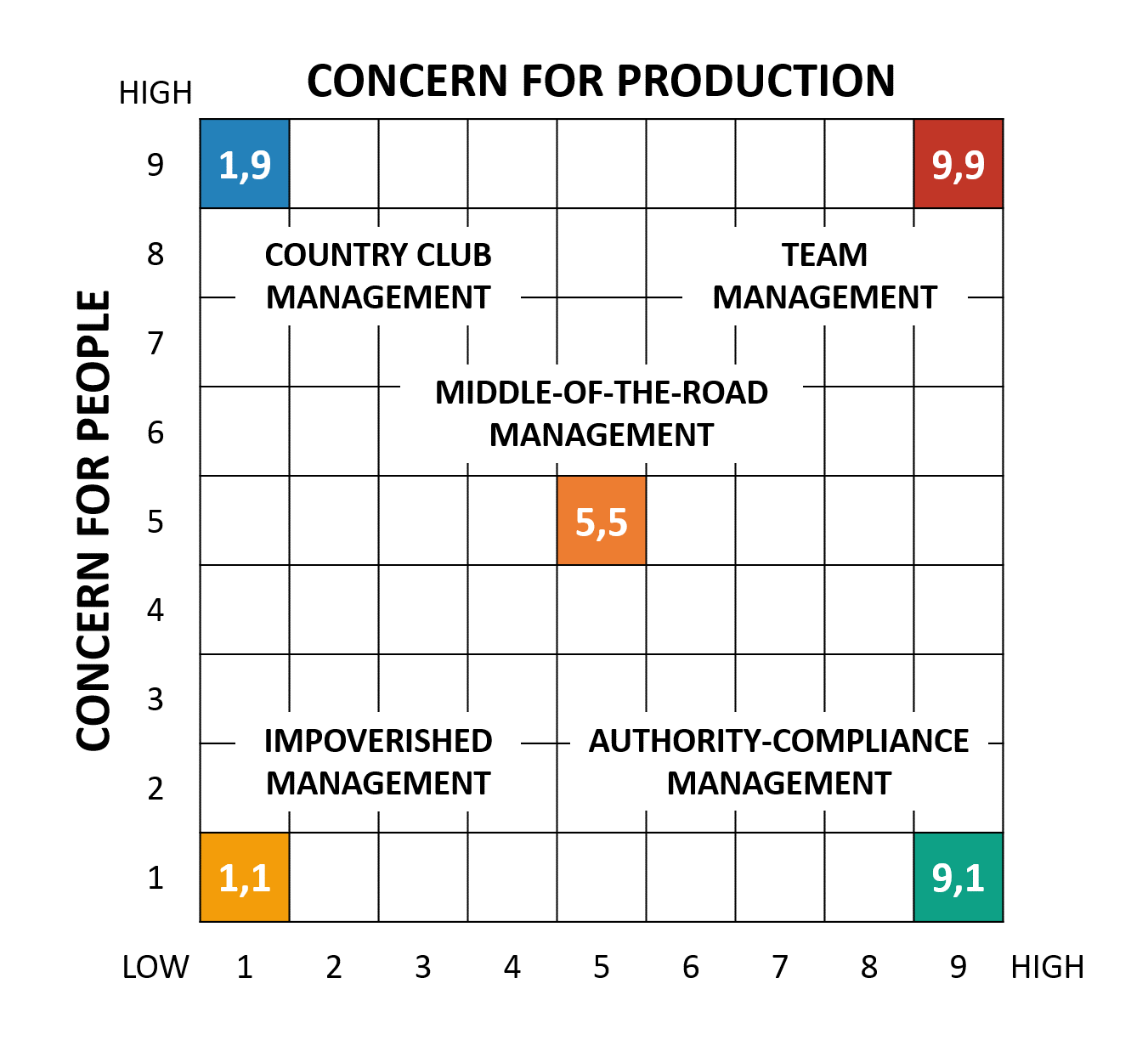
Blake and Mouton Managerial Grid
Source: https://www.business-to-you.com/blake-mouton-managerial-grid/
Aspects of the situation that determine which task-oriented and relations-oriented behaviors are most relevant include the type of team or organization, the nature of the task, and characteristics of subordinates (e.g., experience, motives, gender and cultural diversity, trust and loyalty, identification with the team).
-----------------------------------------------------------------
Guidelines for using the Behavior Effectively
In the remainder of this topic, specific types of task and relations behavior are explained and guidelines provided for using the behaviors effectively in most situations where they are relevant. The guidelines are based on applied research in leadership, on suggestions by practitioners, and on relevant theory and research in the management literature (e.g., project management, operations management, performance management, and human resources
management).
Specific Tasks-Oriented Leader Behaviors
Planning Work Activities
Planning is mostly a cognitive activity involving the processing of information, analyzing, and deciding. Planning seldom occurs in a single behavior episode; instead, it tends to be a prolonged process that occurs over a period of weeks or months.
For example, making decisions about objectives, priorities, strategies, organization of the work, assignment of responsibilities, scheduling of activities, and allocation of resources among different activities according to their relative importance
Guidelines for Action Planning
- Identify the necessary action steps.
- Identify the optimal sequence of action steps.
- Estimate the time needed to carry out each action step.
- Determine starting times and deadlines for each action step.
- Estimate the cost of each action step.
- Determine who will be accountable for each action step.
- Develop procedures for monitoring progress.
Clarifying Roles and Objectives
Clarifying is the communication of plans, policies, and role expectations. Major subcategories of clarifying include (1) defining job responsibilities and requirements, (2) setting performance goals, and (3) assigning specific tasks. The purpose of clarifying behavior is to guide and coordinate work activity and make sure people know what to do and how to do it. It is essential for each subordinate to understand what duties, functions, and activities are required in the job and what results are expected. Even a subordinate who is highly competent and motivated may fail to achieve a high level of performance if confused about responsibilities and priorities. Such confusion results in misdirected effort and neglect of important responsibilities in favour of less important ones. The more complex and multifaceted the job, the more difficult it is to determine what needs to be done.
Guidelines for Clarifying Roles and Objectives
- Clearly explain an assignment
- Explain the reason for the assignment
- Check for understanding of the assignment
- Provide any necessary instruction on how to do the task
- Explain priorities for different objectives or responsibilities
- Set specific goals and deadlines for important tasks
Monitoring Operations and Performance
Monitoring involves gathering information about the operations of the manager’s organizational unit, including the progress of the work, the performance of individual subordinates, the quality of products or services, and the success of projects or programs. Monitoring can take many forms, including observation of work operations, reading written reports, watching computer screen displays of performance data, inspecting the quality of samples of the work, and holding progress review meetings with an individual or group. Many organizations use video cameras to observe operations and increase security, and monitoring of telephone calls and internet correspondence is commonly used to check on quality for customer service representatives. To assess performance for retail facilities and service centers, it is sometimes useful to have somebody disguised as a customer visit them to observe how well the employees provide customer service. The appropriate type of monitoring depends on the nature of the task and other aspects of the situation.
Guidelines for Monitoring Operations
- Identify and measure key performance indicators.
- Monitor key process variables as well as outcomes.
- Measure progress against plans and budgets.
- Develop independent sources of information about the performance
- Conduct progress review meetings at appropriate times.
- Observe operations directly when it is feasible.
- Ask specific questions about the work.
- Encourage reporting of problems and mistakes.
- Use information from monitoring to guide other behaviors
Guidelines for Solving Operational Problems
- Anticipate operational problems and prepare for them.
- Learn to recognize early warning signs for an impending problem.
- Quickly identify the cause and scope of the problem.
- Look for connections among problems.
- Direct the response to the problem in a confident and decisive way.
- Keep people informed about the problem and what is being done to resolve it.
- Be willing to explore innovative solutions
Specific Relations-Oriented Leader Behaviors
Supportive leadership
Supportive leadership (or “supporting”) includes a wide variety of behaviors that show consideration, acceptance, and concern for the needs and feelings of other people. Supportive leadership helps to build and maintain effective interpersonal relationships. A manager who is considerate and friendly toward people is more likely to win their friendship and loyalty. The emotional ties that are formed make it easier to gain cooperation and support from people on whom the manager must rely to get the work done. It is more satisfying to work with someone who is friendly, cooperative, and supportive than with someone who is cold and impersonal, or worse, hostile, and uncooperative. Improvements in job satisfaction are likely to result in less absenteeism, less turnover, less alcoholism, and less drug abuse (Brief, Schuler, & Van Sell, 1981; Ganster, Fusilier, & Mayes, 1986; Kessler, Price, & Wortman, 1985). Supportive leadership may increase a subordinate’s acceptance of the leader, trust of the leader, and willingness to do extra things for the leader. It includes:
Guidelines for Supporting
- Show acceptance and positive regard.
- Show interest in the person as an individual
- Provide sympathy and support when the person is anxious or upset.
- Bolster the person’s self-esteem and confidence.
- Be willing to help with personal problems.
Oprah Winfrey, founder of Oprah Winfrey Network, is an employee-oriented leader. Her compassionate and nurturing behavior towards subordinates helps them realize their full potential, inspires them to succeed, and results in their loyalty and job satisfaction. Caring for her employees has contributed to Oprah’s success as an entrepreneur and business leader |
 INSIGHTS
Developing Subordinate Skills
Developing includes several managerial practices that are used to increase a subordinate’s skills and facilitate job adjustment and career advancement. Key component behaviors include mentoring, coaching, and providing developmental opportunities. Developing is usually done with a subordinate, but it may also be done with a peer, a colleague, or even with a new, inexperienced boss. Responsibility for developing subordinates can be shared with other members of the work unit who are competent and experienced. For example, some leaders assign an experienced subordinate to serve as a mentor and coach for a new employee.
Guidelines for Developing Subordinates
- Show concern for each person’s development.
- Help the person identify ways to improve performance.
- Be patient and helpful when providing coaching.
- Provide helpful career advice.
- Help the person prepare for a job change.
- Encourage attendance at relevant training activities.
- Provide opportunities to learn from experience.
- Encourage coaching by peers when appropriate.
- Promote a person’s reputation.
Providing Praise and Recognition
Recognizing involves giving praise and showing appreciation to others for effective performance, significant achievements, and important contributions to the organization. Although it is most common to think of recognition as being given by a manager to subordinates, this managerial practice can also be used with peers, superiors, and people outside the work unit. The primary purpose of recognizing, especially when used with subordinates, is to strengthen desirable behavior and task commitment. Recognizing is primarily a relations behavior, but like developing, it can contribute to the attainment of task objectives as well.
- Three major forms of recognizing are praise, awards, and recognition ceremonies. Praise consists of oral comments, expressions, or gestures that acknowledge a person’s accomplishments and contributions. It is the easiest form of recognition, but it is under-utilized by many managers.
- Awards include things such as a certificate of achievement, a letter of commendation, a plaque, a trophy, a medal, or a ribbon. Awards can be announced in many different ways, including an article in the company newsletter, a notice posted on the bulletin board, a picture of the person (e.g., “employee of the month”) hung in a prominent place, over a public address system, in regular meetings, and at special ceremonies or rituals.
- A recognition ceremony ensures that an individual’s achievements are acknowledged not only by the manager but also by other members of the organization. Recognition ceremonies can be used to celebrate the achievement of a team or work unit as well as those of an individual.
Guidelines for Developing Subordinates
- Show concern for each person’s development.
- Help the person identify ways to improve performance.
- Be patient and helpful when providing coaching.
- Provide helpful career advice.
- Help the person prepare for a job change.
- Encourage attendance at relevant training activities.
- Provide opportunities to learn from experience.
- Encourage coaching by peers when appropriate.
- Promote a person’s reputation.
Exercise PEOPLE-ORIENTED or TASK-ORIENTED? Think of specific situations in which it might be especially important for a manager to engage in |

No comments:
Post a Comment
Note: Only a member of this blog may post a comment.