International Marketing Research
By the end of this topic, you should be able to:
- Discuss the breadth and scope of market research in the context of the international market and the four steps involved in the research process;
- Explore the issues of the availability of secondary data and the need to validate data; and
- Elaborate on the problems faced in gathering primary data.
INTRODUCTION
|
 VIDEO LESSON:
Information is a critical factor in formulating and implementing a successful marketing strategy. Given the complexity of today's fast-changing world and the unpredictability of consumer demands, marketing research is essential for a company to reduce serious risks associated with marketing a product. Thus, the purpose of this topic is to examine the nature and techniques of international marketing research. In addition to this, the process and challenges of gathering data in international markets will also be explained. The discussion will focus on the difficulties associated with cross-cultural research and the necessity of adapting marketing research techniques to the international market.
THE NATURE OF MARKET RESEARCH
Marketing research involves the "systematic gathering, recording, and analysing of data about problems relating to the marketing of goods and services". In this context, international marketing research is carried out on an international scale. Generally speaking, international marketing research can be defined as research that crosses national borders and involves respondents and researchers from different countries and cultures.
|
The challenge of international marketing research is to recognise and respond to the national differences that influence the way information can be obtained. These include cultural, linguistic, economic, political, religious, historical, and market differences. The objectives of international market research are similar to the objectives of domestic research. However, five specific environmental factors that may require international research efforts to be conducted differently from domestic research:
- Researchers must be prepared for new parameters for doing business;
- Not only will there be different requirements, but the ways in which rules are applied may differ as well;
- Cultural mega shock may occur as company personnel come to grips with a new set of culture-based assumptions about conducting business;
- Entering more than one new geographic market may result in a burgeoning network of interacting factors; research may help prevent psychological overload; and
- Company researchers may have to broaden the definition of competitors in international markets to include competitive pressures that would not be present in the domestic market.
STEPS IN THE RESEARCH PROCESS
The process of collecting data and converting it into useful information is shown in detail below. In the discussion that follows, the steps in the research process will be presented and elaborated upon.
|
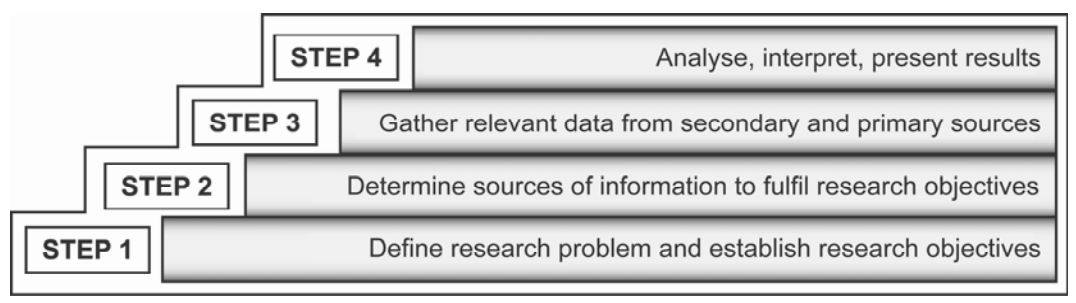
Step 1: Define the Research Problem and Establish Research Objectives
This step is the most difficult and crucial step, where the researcher has to convert a series of often ambiguous business problems into a pragmatic and achievable research objective. This first task, which sounds deceptively simple, may be the pivotal task in the entire study. In defining the problem, there are two important considerations that a researcher has to observe; namely the market structure and the product concept.
|
- Market structure refers to the size of the market, its stage of development, the number of competitors and their market shares, and the channels through which the market is approached.
- A product may be viewed differently in different cultures. Before attempting to define the marketing research problem, exploratory research may be necessary to understand the product concept, that is, the meaning of the product in a particular environment.
For example, Berent points out that milk-based products are viewed very differently in the United Kingdom and Thailand. In Britain, milk-based products are usually consumed at meals and bedtime for their sleep-inducing, soothing, relaxing properties. In Thailand, the same products are consumed on the way to work and often away from home for they are considered invigorating, energising, and refreshing.
Let us assume a multinational marketer is interested in finding out the potential market for a brand of yogurt in Britain and Thailand. In this context, the definition of the problem in the two countries will have to be stated differently. In the United Kingdom, yogurt might be primarily perceived by the consumers as a healthful and relaxing product to be consumed prior to retiring. In Thailand, the research problem would be to determine if yogurt would be considered mainly as an energy food that is eaten to start the day. |

Step 2: Determine the Sources of Information to Fulfil the Research Objectives
After the problem has been defined, the next step is to determine where the necessary information is located and how to obtain it. In some cases, the study may be confined to secondary data, that is, published information that has been collected elsewhere. Secondary data may be available for free (e.g. from government statistics), or for
a price (e.g. from syndicated research suppliers) or through restricted distribution sources (e.g. from trade association statistics).
|
| Let us assume that the Ford Motor Company is interested in assembling its new car in collaboration with an Indian company. Before committing itself to the joint venture, Ford would like to study the car's market potential in India over a ten-year period. Fortunately, the Indian government collects a variety of socioeconomic-demographic information on a regular basis. Ford, therefore, can use such secondary information as population projections, income data, consumer expenditure patterns and rural-urban population shifts to assess the market potential. |
Sometimes internal data are also useful. Existing files can often provide important insights into the question at hand. In the above example, Ford might have found that it already had sufficient information on population trends in India gathered when the company had earlier negotiated the assembly of tractors there.
In cases where the secondary sources or internal data cannot provide the necessary information, primary data will have to be compiled from scratch through interviews and other direct collections of information. Primary data may be gathered in various ways, from trade association representatives, government experts, managerial personnel and/or the buying public.
For example, a company may be interested in introducing its fabricated houses in Malaysia. The company would have to study house-buying behaviour in the target country. Since this type of information may not be available from secondary sources, primary data gathering is therefore necessary.
House ownership in different countries could also have completely different implications. The saying that "a man's home is his castle" is far more applicable in the United Kingdom than in the United States, where the geographic and social mobility of the population means that the regular exchange of homes is a commonplace experience during the life cycle of most families. Therefore, the decision-making patterns of a husband and wife, and the amount of effort spent in making a home-buying decision should be quite different between these two countries. Thus, the company has to learn through primary research the ways in which "houses" might mean "home" in various locales. |

Step 3: Gather the Relevant Data from Secondary and Primary Sources
The actual collection of data must be planned and executed carefully. It should be noted here that tracking down reliable, usable data sources can be time-consuming. Thus, the use of personnel with knowledge of the country could help appraise what progress is being made. Interview questions must be tested for their appropriateness so that they produce the desired results.
|
In developing a questionnaire, the researcher needs to conduct professional level interviews in two phases:
(a) Collect basic data; and
(b) Explore interview questions not anticipated at the start of the project.
Once the basic data has been collected, the process of cross-checking can begin. This step requires that all information be examined critically for its relevance. Cross-checking establishes the reliability of data by comparing one source with another.
Step 4: Analyse, Interpret and Present the Results
In the final step of the preparation of the report, the data must be analysed and interpreted. Here too, attention should be given to the cultural traits of the country under study.
|
| For example, in an examination of the beer market, it was found that beer was perceived as an alcoholic drink in Northern European countries, but was considered a soft drink in Mediterranean countries. As such, other products listed together with beer as alternative drinks would influence the research findings. Similarly, in Japan non-carbonated fruit juices are often substituted for bottled soft drinks. This is different in the United States. In brief, the significance of different perceptions of the same product in various countries must be taken into account. |
Reports must be complete, factual and objective. It is particularly important to communicate the reliability as well as the limitations of the facts presented. Particular attention should be given to the following aspects of a report:
- Data sources must be identified. Different sources of data warrant varying degrees of confidence. For example, information on a Third World country obtained from the Malaysian Agency for International Development is probably more reliable than information gathered from the government of that country;
- Data projection must be explained. The statistical computations should be simplified as much as possible. A detailed description of the statistical procedures should be included in the appendix;
- The identity of all those interviewed should be included as well as their titles or qualifications. (Note that this rule does not apply to consumer research). When anonymity has been guaranteed, this requirement may have to be relaxed;
- The alternative nature courses of action developed from analysis and interpretation of the data must be labelled as such, clearly reserving to management the responsibility for selecting the appropriate course of action.
AVAILABILITY AND USE OF SECONDARY DATA
It seems that secondary data available in a foreign country has many problems and deficiencies in comparison with similar information available in the United States. Thus, the researcher must be aware of problems and deficiencies when interpreting information. The following deals with some of the issues that need to be considered when processing data.
| Availability of Data In many developing nations, secondary data is very scarce. Information on retail and wholesale trade is especially difficult to obtain. In such cases primary data (PD) collection becomes vital. |
| Reliability of Data The reliability may be affected by data collection procedures. For example, the sample may not be very random, so the results cannot be assumed to reflect the behaviour of the total population. Even when a good sampling plan has been laid out, it may not be properly adhered to (that is, the interviewers might substitute subjects when those required by the sampling plan cannot be reached). In brief, numerous factors may affect the reliability of data. It may be difficult for the researcher to judge the reliability of secondary data available in a country. If the researchers are indeed concerned with reliability, they would be better off undertaking primary data collection. |
| Comparability of Data Multinational corporate executives often like to compare information on their host countries about matters such as reviews of market performance, strategy effectiveness in different environments and so on. Unfortunately, the secondary data obtained from different countries is not readily comparable. |
| Validating Secondary Data Checking the consistency of one set of secondary data with other data of known validity is an effective and often the employed method of judging validity. For example, a researcher might check the sale of baby products with a number of women of childbearing age and with high birthrates. The researcher may also check the number of patient beds in hospitals with the sale of related hospital equipment. |
| The Underlying Purpose of Data Collection Generally, the single most important source of marketing-related secondary data in a country is the government. The government as a political institution may not approach data collection with the same objectivity as a business researcher. This problem is particularly severe in developing countries where governments may enhance the information content in order to paint a rosy picture of economic life in the country. In this way, political considerations overshadow the reliability of the data. Thus, the researcher must ascertain that the data available is accurate within the limits of its source and that there are no hidden assumptions that might distort the information from the researcher's point of view. |
| Currency of Information Information gathering is an expensive activity. When the government has limited resources, data gathering becomes unimportant. Therefore, information may not be gathered as frequently as desired. The researcher needs to be very careful that the information available overseas has not become outdated. |
| Data Classification Another problem has to do with the classification scheme of available data. In many countries, the data reported are too broadly classified for use at the microlevel. For example, in Thailand, the category "construction equipment, machine and tools" includes large bulldozers as well as hand-operated drills. Therefore, a company that is interested in manufacturing heavy construction machines in Thailand may not be able to get a clear idea about the current availability of such equipment in the country from the information given under such a category. |
SELF-CHECK: REFLECTION
In your opinion, why must a researcher be aware of problems and deficiencies when interpreting information? |

PRIMARY DATA
Where secondary data do not provide adequate information input for management decision-making, primary data collection will be required. The collection of such data often entails high costs relative to its perceived value. This stems from difficulties encountered in international marketing research.
Some of the factors include a lack of experience in many markets which may mean that more background data will need to be collected. Furthermore, the data are often less accurate or reliable than in comparable domestic studies. Primary data presumably provide more relevant information because they are collected specifically for this purpose in mind.
Problems in Gathering Primary Data
Primary data collection in a foreign environment poses a variety of problems that are rarely encountered in developed countries. These problems are related to social and cultural factors and the level of economic development, and can be grouped under three headings:
(a) Ability to Communicate Opinions The ability to express attitudes and opinions about a product or concept depends on the respondentÊs ability to recognise the usefulness and value of such a product or concept. It is difficult for a person to formulate needs, attitudes and opinions about goods whose use may not be understood, or those that are not in common use within the community, or those that are not available there. For example, to describe their likes and dislikes of a product or describe the atmosphere of the department store they prefer to patronise, most respondents may be unable to phrase their answers. Respondents are unable to articulate certain types of responses. |
(b) Willingness to Respond Even if the interviewee is successfully reached, there is no guarantee that he or she will cooperate and furnish the desired information. There are many reasons why an interviewee is non-responsive:
|
(c) Sampling in Field Surveys A good piece of research should reflect the perspectives of the entire population. This is feasible only when the sample is randomly drawn. Unfortunately, in many countries it is difficult to get completely representative information on the socioeconomic characteristics of the population because such information is lacking or inadequate. Thus, most samples obtained in the end are biased. the problems encountered in drawing a random sample include: (i) No officially recognised census of population; (ii) No other listings that can serve as sampling frames; (iii) Incomplete and out-of-date telephone directories; and (iv) No accurate maps of population centres. Hence, no cluster (area) samples can be made. Street maps are unavailable and streets are unidentified and houses are not numbered. |
d) Language and Comprehension In many countries, different languages are spoken in different areas. Thus, the questionnaire has to be in different languages for use within the same country. For example, in India, fourteen official languages are spoken in different parts of the country, while most governments and business affairs of many countries are conducted in English. Similarly in Switzerland, German is used in some areas and French in others. Unfortunately, translating a questionnaire from one language to another is far from easy. In the translating process, many points may be left out entirely, because many idioms, phrases and statements mean different things in different cultures. For example, a Danish executive observed that meanings could change when translated and retranslated back to its original language. In this case, in a statement that was originally written in English and then translated into Danish, and finally translated back into English by a different translator, the statement changed from: "out of sight, out of mind", to "invisible things are insane". Marketers use two basic methods to help overcome translation errors: forward translation and back translation (i) Forward Translation In the case of forward translation, a single translator or group of translators prepares a translation from the source language into the target language. Several versions can be prepared and then they are compared. This approach is subject to the risk that the translation may contain errors and not accurately represent the meaning of the original or "source" questionnaire. Difficulties encountered in finding equivalent words or phrases in the target language may result in errors. (ii) Back Translation The back translation method is the best known and most popular method. Following this procedure, a questionnaire is translated from the initial or source language by a bilingual translator who is a native speaker of the target language into which the translation is being made. This version is then translated back into the original or source language by a bilingual translator who is a native speaker of that target language. The two versions are then compared in the source language to check for errors and the quality of the translation. This approach is useful in identifying translation errors and the competency of the translator. |

No comments:
Post a Comment
Note: Only a member of this blog may post a comment.