NTRODUCTION
The purpose of a business is to create and maintain satisfied, profitable customers. Customers are attracted and retained when their needs are met. When a business satisfies its customers, the customers will pay a fair price for the product, which includes a profit for the firm. Therefore, it is wise to assess the customer’s long-term value and take appropriate actions to ensure a customer’s long-term support. For example, a hotel that can increase its repeat customers from 35 to 40 percent should gain at least an additional 25 percent in profits.
So, what is Marketing?
Marketing is the process by which companies create value for customers and society, resulting in strong customer relationships that capture value from the customers in return. Marketing is the art and science of finding, retaining, and growing profitable customers.
Importance of Marketing
The entrance of corporate giants into the hospitality market and the marketing skills these companies have brought to the industry have increased the importance of marketing within the industry.
Analysts predict that the hotel industry will consolidate in much the same way as the airline industry has, with five or six major chains dominating the market. Such consolidation will create a market that is highly competitive. The firms that survive this consolidation will be the ones that understand their customers.
In response to growing competitive pressures, hotel chains are relying on the expertise of the marketing director.
Marketing means “hitting the mark.”
According to Peter Drucker: “The aim of marketing is to make selling superfluous. The aim is to know and understand customers so well that the product or service fits them and sells itself.” This does not mean that selling and promotion are unimportant, but are part of a larger set of marketing tools that work together to produce satisfied customers.
|

Marketing Process
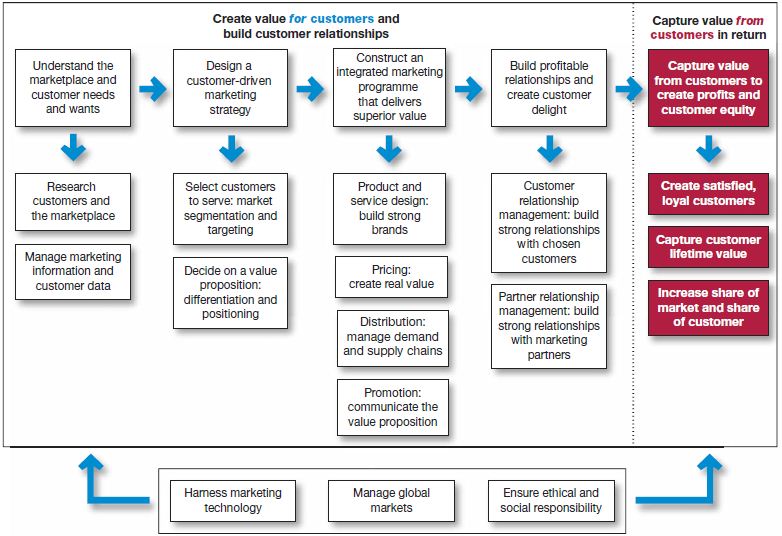
The marketing process is a five-step model of the marketing process. In the first four steps, companies work to understand consumers, create customer value, and build strong customer relationships. In the final step, companies reap the rewards of creating superior customer value. By creating value for customers, they in turn capture value from customers in the form of sales, profits, and long-term customer equity. >Read more<
Needs - A human need is a state of felt deprivation. Included are:
The basic physical needs for food, clothing, warmth, and safety
Social needs for belonging, affection, fun, and relaxation
Esteem needs - prestige, recognition, and fame
Individual needs for knowledge and self-expression
Wants - The form human needs take as they are shaped by culture and individual personality
As society evolves, the wants of its members expand. Be careful not to confuse wants with needs
For example, a manufacturer of drill bits may think that customers need a drill bit, but what the customers really need is a hole (aka “marketing myopia”)
The Explainer: Don’t Just Sell Stuff — Satisfy Needs Source: Harvard Business Review |
 Learn from Video:
 Demands - People have almost unlimited wants, but limited resources. Therefore, wants to become demands when backed by buying power
Exchange is the act of obtaining a desired object from someone by offering something in return
Beyond simply attracting new customers and creating transactions, the goal is to retain customers and grow their business with the company
Marketers want to build strong relationships by consistently delivering superior customer value
Customer value is the difference between the benefits that the customer gains from owning and/or using a product and the costs of obtaining the product
Customer expectations are based on past buying experiences, the opinions of friends, and market information
Customer satisfaction depends on a product’s perceived performance in delivering value relative to a buyer’s expectations
Five Marketing Management Philosophies (Orientation)
There are five alternative concepts under which organizations design and carry out their marketing strategies: the production, product, selling, marketing, and marketing 3.0
Production
Belief that consumers will favour products that are available and highly affordable, and therefore management should focus on production and distribution efficiency
Problem: The management may become so focused on production systems that they forget the customer.
Product
Belief that consumers will favour products that offer the most in quality, performance, and innovative features Problem: Focusing only on the company’s products can lead to marketing myopiaSelling
Belief that consumers will not buy enough of the organization’s products unless the organization undertakes a large selling and promotion effort
Problem: Doesn’t establish a long-term relationship with the customer because the focus is on getting rid of what one has, rather than creating a product to meet the needs of the marketMarketing
Belief that achieving organizational goals depends on determining the needs and wants of target markets and delivering the desired satisfaction more effectively and efficiently than competitors
Problem: Niche opportunities may sometimes remain available long after suppliers recognize the need
Benefits: Focuses on customer needs and integrates all the marketing activities that affect customers, thereby meeting the organizational goals by creating long-term customer relationships based on customer value and satisfactionSocietal Marketing
The societal marketing concept questions whether the pure marketing concept overlooks possible conflicts between consumer short-run wants and consumer long-run welfare. The societal marketing concept holds that marketing strategy should deliver value to customers in a way that maintains or improves both the consumer’s and society’s well-being.
Main Responsibilities of the Marketing Department in Organisation
Identifying market opportunities
It should research the needs and wants of the different types of customers to be found in the marker. It needs to be aware of technological developments taking place in order to identify the trends in the demand pattern for existing products and market opportunities for new products.
Managing Product
Forecasting and managing the rate of supply and distribution of the company’s existing products. Equally important will be its prime role in determining what new products should be developed and launched into various markets.
Choosing and motivating the channels of distribution
A manufacturer must use distributors to stock and sell its products on its behalf. It must select those wholesalers and retailers who will best look after its interests, and who wish to buy such merchandise from amongst the wide choice of competing suppliers.
Advertising and promoting products and services
The marketing department will be responsible for communicating to target market customers the existence of its products and the benefits to be obtained from purchasing them. It aims to stimulate the potential buyer into becoming interested in purchasing.
Setting prices and terms of supply
It involved in agreeing and setting market prices, terms of supply, and payment conditions. Other functional activities such as finance and credit control will also be involved in this important business area.

No comments:
Post a Comment
Note: Only a member of this blog may post a comment.