MARKETS AND THE MARKETING ENVIRONMENT
OVERVIEW
In this topic, students are introduced to marketing environment and explore ways in which economic, political, legal, and cultural issues influence global, as well as domestic, marketing strategies and outcomes. These issues also affect whether or not businesses choose to enter a global market. Students also learn that if a business does enter a global market, the level of commitment is directly related to the level of control. Ethical business practices are important for the firm to do its best for stakeholders and to avoid the consequences of low ethical standards. Many firms practice sustainability when they develop target marketing, product, price, place/distribution, and promotion strategies designed to protect the environment.
|
 Introduction (Duration: 2.00 minutes)
After studying this topic, students should be able to:
- Examine how factors in a firm’s external business environment influence marketing strategies and outcomes in both domestic and global markets.
- Explain some of the strategies and tactics that a firm can use to enter global markets.
- Explain the importance of ethical marketing practices and the role of sustainability in marketing planning.
|
|
ANALYZE THE EXTERNAL MARKETING ENVIRONMENT
Whether or not you have decided to venture into a foreign market, it is essential to understand your external environment. For firms that choose to limit themselves to their domestic market, having a sharp picture of the marketing environment allows them to make good decisions about marketing strategies. If you’ve decided to go global, understanding local conditions in a potential new country or regional markets helps you to figure out just where to go.
The Economic Environment
Understanding the economy of a country in which a firm does business is vital to the success of marketing plans.
|
a. Indicators of Economic Health
- The most commonly used measure of the economic health of a country is the gross domestic product (GDP): the total dollar value of goods and services a country produces within its borders in a year. In addition to total GDP, marketers may also compare countries based on per capita GDP: the total GDP divided by the number of people in a country.
- GDP and exchange rates alone do not provide the information marketers need to decide if a country’s economic environment makes for an attractive market. They must consider economic infrastructure, the quality of distribution, financial, and communications systems.
b. Level of Economic Development
- The level of economic development takes into consideration the broader economic picture of a country.
- A country’s standard of living is an indicator of the average quality and quantity of goods and services a country consumes.
- Economists describe the following three basic levels of development:
- A country at the lowest stage of economic development is an LDC. In most cases, its economic base is agricultural. In least developed countries, the standard of living is low, as are literacy levels. Bottom of the pyramid (BOP) is the name for four billion consumers who live on less than $2 a day.
- When an economy shifts its emphasis from agriculture to industry, standards of living, education, and the use of technology improve. These countries are developing countries. In such locales, there may be a viable middle class, often largely composed of entrepreneurs working hard to run successful small businesses. Because over eight out of 10 consumers now live in developing countries, the number of potential customers and the presence of a skilled labor force attract many firms to these areas. The largest of the developing countries, Brazil, Russia, India and China, are referred to as the BRIC countries or simply as the BRICs. These four countries are the fastest growing of the developing countries and they represent over 42 percent of the world’s population.
- A developed country boasts sophisticated marketing systems, strong private enterprise, and bountiful market potential for many goods and services. Such countries are economically advanced, and they offer a wide range of opportunities for international marketers. The United States, the United Kingdom, Australia, Canada, France, Italy, Germany, and Japan are the most economically developed countries in the world. In 1975, they established the Group of Seven (G7) to serve as an informal forum for these nations (Russia’s membership was revoked because of its involvement in the Crimean crisis).
c. The Business Cycle
- The business cycle is the overall pattern of changes or fluctuations of an economy. All economies go through cycles of prosperity (high levels of demand, employment, and income), recession (falling demand, employment, and income), and recovery (gradual improvement in production, lowering unemployment, and increasing income). A severe recession is a depression; a period during which prices fall but there is little demand because few people have money to spend and many are out of work. Inflation occurs when prices and the cost of living rise while money loses its purchasing power because of the cost of goods escalates.
The Competitive Environment
Firms must keep abreast of what the competition is doing so they can develop new product features, new pricing schedules, or new advertising to maintain or gain market share.
An increasing number of firms around the globe engage in competitive intelligence (CI) activities, the process of gathering and analyzing publicly available information about rivals. The firm uses this information to develop superior marketing strategies.
a. Competition in the Microenvironment
- Competition in the microenvironment means the product alternatives from which members of a target market may choose.
- We think of these choices at three different levels. At a broad level, marketers compete for consumers’ discretionary income: the amount of money people have left after paying for necessities such as housing, utilities, food, and clothing. A second type of choice is product competition, in which competitors offering different products attempt to satisfy the same consumers’ needs and wants. The third type of choice is brand competition, in which competitors offering similar goods or services vie for consumer dollars.
b. Competition in the Macroenvironment
|
- When we talk about examining competition in the macroenvironment, we mean that marketers need to understand the big picture—the overall structure of their industry.
- Four structures describe differing amounts of competition.
- A monopoly exists when one seller controls a market.
- In an oligopoly, there are a relatively small number of sellers, each holding substantial market share, in a market with many buyers.
- In a state of monopolistic competition, many sellers compete for buyers in a market.
- Finally, perfect competition exists when there are many small sellers, each offering the same good or service.
Tools for Competitor Analysis: Porter's Five Forces Model
|
Porter's summary of the forces which govern industrial competition provides us with a rationale that underpins the "mechanical" aspect of a management audit.
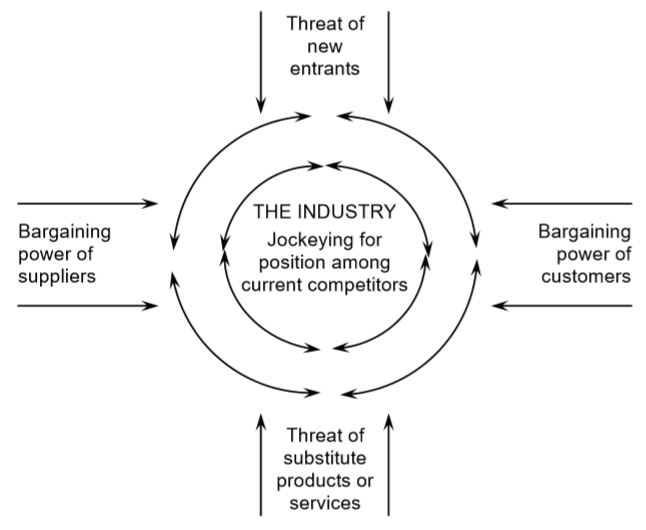
Porter has suggested that it is the "collective strength of these forces which determines the ultimate profit potential of an industry". The aim of a corporate strategist is to find a position in the industry where the organisation can defend itself against these forces or can influence them in its favour.
| Reading: Porter, M.E., (1980) How competitive forces shape strategy. The McKinsey Quarterly Spring 1980 pp. 34-50 |
The Technological Environment
|
Changes in technology profoundly affect marketing activities. Amazon had been working on drones, unmanned aircraft controlled by a GPS, to deliver packages. A second game-changing innovation is the self-driving, driverless, or autonomous vehicle. A patent is a legal document that grants inventors exclusive rights to produce and sell a particular invention in that country. Marketers monitor government patent applications to discover innovative products they can purchase from the inventor.
What role has technology played in the globalization of businesses? Give at least one example of each and explain your view. |
 SELF-CHECK: REFLECTION
The Political and Legal Environment
The political and legal environment refers to the local, state, national, and global laws and regulations that affect businesses.
|
a. Political Constraints on Trade
- Global firms know that the political actions a government takes can drastically affect their business operations. Short of war, a country may impose economic sanctions that prohibit trade with another country (as the United States has done with several countries, including Cuba and North Korea), so access to some markets may be cut off.
- Nationalization occurs when the domestic government reimburses a foreign company (often not for the full value) for its assets after taking it over.
- Expropriation occurs when a domestic government seizes a foreign company’s assets (and that firm is just out of luck). Now that the United States has normalized relations with Cuba, it remains to be seen if these firms seek reimbursement for their lost property.
b. Regulatory Constraints on Trade
- Governments and economic communities regulate what products are allowed in the country, what products should be made of, and what claims marketers can make about them.
- Local content rules are a form of protectionism stipulating that a certain proportion of a product must consist of components supplied by industries in the host country or economic community.
c. Human Rights Issues
- Some governments and companies are vigilant about denying business opportunities to countries that mistreat their citizens. They are concerned about conducting trade with local firms that exploit their workers or that keep costs down by employing children or prisoners for slave wages.
The Sociocultural Environment
|
Another element of a firm’s external environment is the socio-cultural environment. This term refers to the characteristics of the society, the people who live in that society, and the culture that reflects the values and beliefs of the society. Whether at home or in global markets, marketers need to understand and adapt to the customs, characteristics, and practices of their citizens.
a. Demographics
- Demographics are statistics that measure observable aspects of a population, such as size, age, gender, ethnic group, income, education, occupation, and family structure.
b. Values
- Every society has a set of cultural values, or deeply held beliefs about right and wrong ways to live, that it imparts to its members. For example, for most Americans, punctuality is a core value; indeed, business leaders often proclaim that “time is money.” For countries in Latin America and other parts of the world, this is not at all true.
- In collectivist cultures, such as those found in Venezuela, Pakistan, Taiwan, Thailand, Turkey, Greece, and Portugal, people tend to subordinate their personal goals to those of a stable community. In contrast, consumers in individualist cultures, such as the United States, Australia, Great Britain, Canada, and the Netherlands, tend to attach more importance to personal goals, and people are more likely to change memberships when the demands of the group become too costly.
c. Social Norms
- Social norms are specific rules dictating what is right or wrong, acceptable or unacceptable.
d. Language
- Language barriers can affect product labelling and usage instructions, advertising, and personal selling.
e. Consumer Ethnocentrism
- Ethnocentrism refers to the belief that one’s own norms and the products made in your country are superior. Consumer ethnocentrism refers to consumers’ beliefs about products produced in their country versus those from another.
Based on Ethnocentrism, list THREE (3) countries and products or stereotypes that you can associate with those countries. For example, chocolate may be associated with Switzerland while durian may be associated with Malaysia. Comment below |

No comments:
Post a Comment
Note: Only a member of this blog may post a comment.