CONSUMER BEHAVIOUR
Overview
In this topic, consumer behavior is defined and reasons for purchasing studied. You will learn about the process of purchase, beginning with prepurchase behavior, and ending with postpurchase behavior. You will understand how situational factors at the time and place of purchase can influence consumer behavior, and begin to think about how consumers’ relationships with other people influence their decision-making process.
After studying this topic, students should be able to:
- Define consumer behavior, and explain the purchase decision-making process.
- Explain how internal factors influence consumers’ decision-making processes.
- Illustrate how situational factors and consumers’ relationships with other people influence consumer behavior.
THE CONSUMER DECISION-MAKING PROCESS
Consumer behavior is the process individuals or groups go through to select, purchase, use, and dispose of goods, services, ideas, or experiences to satisfy their needs and desires. Consumer decision making is an ongoing process—it’s more than what happens at the moment a consumer pays for a product. Marketers need to understand the many factors that influence each step in the consumer-behavior process—internal factors unique to each of us, situational factors at the time of purchase, and the social influences of people around us.
|
 VIDEO LESSON:
Not All Decisions Are the Same
- Decision-makers actually employ a set of approaches that range from painstaking analysis to pure whim, depending on the importance of what they are buying and how much effort they choose to put into the decision. Researchers find it convenient to think in terms of an “effort” continuum that is anchored on one end by habitual decision making, such as deciding to purchase a box of cereal, and at the other end by extended problem solving, such as deciding to purchase a new car.
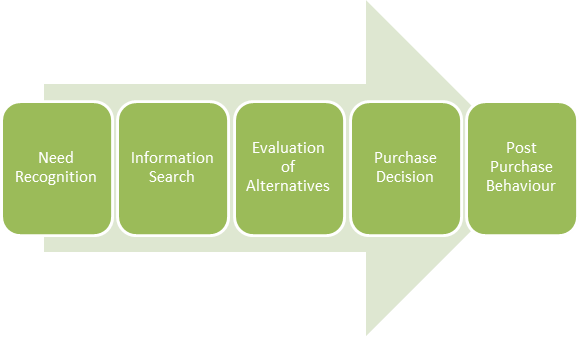
Figure: The Consumer Decision-Making Process
- The figure above shows the decision-process continuum and some of the differences between extensive problem solving, limited problem solving, and habitual decision making. Of course, habitual decision making, limited problem solving, and extensive problem solving are not discrete categories. Rather, we think of our product purchases as being on a continuum on which each purchase we make is at a slightly different point.
- With habitual decision making, consumers make little or no conscious effort. Many decisions fall somewhere in the middle and are characterized by limited problem solving. This means that consumers do some work to make a decision but not a great deal.
- The effort we put into decisions depends on our level of involvement. Involvement is the importance of the perceived consequences of the purchase to the person. We tend to be more involved in the decision-making process for products that we think are risky in some way. Perceived risk exists when there is uncertainty about a product, the product is complex or hard to understand, the buyer will be embarrassed if he/she chose the wrong product, etc.
- When the perceived risk is low—like when you buy a box of cereal—we experience a small amount of involvement in the decision-making process. In low-involvement situations, the consumer’s decision is often a response to environmental cues, such as when you decide to try a new type of cereal because the grocery store prominently displays it at the end of the aisle.
- Under these circumstances, managers must concentrate on how a store displays products at the time of purchase to influence the decision-maker. For high-involvement purchases, such as when we buy a house or a car, we are more likely to carefully process all the available information and to have thought about the decision well before we buy the item. The consequences of the purchase are important and risky, especially because a bad decision may result in significant financial losses, aggravation, or embarrassment.
Step 1: Problem Recognition
|
- Problem recognition occurs whenever a consumer sees a significant difference between her current state of affairs and some desired or ideal state.
- Most problem recognition occurs spontaneously. However, marketers can develop creative advertising messages that stimulate consumers to recognize that their current state just doesn’t equal their desired state.
Step 2: Information Search
|
- Information search is the step of the decision-making process in which the consumer checks his or her memory and surveys the environment to identify what options might solve his or her problem. Advertisements on TV, information on the Internet, and videos provide guidance. The information search step includes discovering what alternatives are available.
- Comparison-shopping agents (shopbots) such as Bizrate.com are web applications that can help online shoppers find what they are looking for at the lowest price.
Step 3: Evaluation of Alternatives
|
- First, a consumer identifies a small number of products of interest and then focuses on the determinant attributes, the features to differentiate among products. In reality, consumers’ search for information and evaluation of alternatives simultaneously.
Step 4: Product Choice
|
- Deciding on one product and acting on this choice is the next step in the decision-making process. Compensatory decision rules refer to the methods for making decisions that allow information about attributes of competing products to be averaged in some way.
- Consumers often rely on decision guidelines when weighing the claims that companies make. These heuristics, or mental rules-of-thumb, help simplify the decision-making process. One such heuristic is “price = quality.” Many people willingly buy the more expensive brand because they assume that if it costs more, it must be better.
- Perhaps the most common heuristic is brand loyalty; this occurs when we buy the same brand repeatedly and as you can guess it’s The Holy Grail for marketers. Consumers who have strong brand loyalty feel that it’s not worth the effort to consider competing options. People form preferences for a favorite brand and then may never change their minds in the course of a lifetime.
- Another heuristic is based on country of origin. We assume that a product has certain characteristics if it comes from a certain country. Sometimes a marketer wants to encourage a country association even when none exists.
Step 5: Postpurchase Evaluation
|
- In the last step of the decision-making process, the consumer evaluates just how good a choice it was. The evaluation of the product results in a level of consumer satisfaction/dissatisfaction, which is determined by the overall feeling, or attitude, a person has about a product after purchasing it.
- How well a product meets or exceeds expectations determines customer satisfaction. Consumers assess product quality by comparing what they have bought to a performance standard created by a mixture of information from marketing communications, informal information sources such as friends and family, and their own experience with the product category. This is why it is very important that marketers create accurate expectations of their products in advertising and other communications.
- Even when a product performs to expectations, consumers may suffer anxiety or regret, or buyer’s remorse, after we make a purchase. When we reject product alternatives with attractive features, we may second-guess our decision.
- Marketers also try to ascertain what influences consumers’ lives affect the decision-making process. There are three main categories: internal, situational, and social influences. A discussion of each follows.
The Hive Mind: Consumer Decision Making in the Digital Age
|
- The moment the consumer decides to make a purchase is called ZMOT-- zero moment of truth. ZMOT occurs on mobile phones, laptops, and other wired devices. Consumers have changed how they make decisions. They spend hours seeking information, even for small purchases.
- The “always on” consumer makes decisions collectively by seeking advice from her social network. The traditional steps in the consumer decision-making process are changing as well.
- Hyperchoice is a term used to describe the condition in which consumers have too many choices, leading them to make poorer decisions and experience greater frustration.
Changes in Consumer Decision Making: Welcome to AI
- Artificial intelligence (AI) is rapidly moving forward in its influence on both consumer and B2B behavior. AI is intelligence demonstrated by machines that enables computer systems to perform such tasks as visual perception, speech recognition, decision making, and language translation.
- Chatbots are computer programs that use voice or text to allow consumers to talk with a computer.
NTERNAL INFLUENCES ON CONSUMERS’ DECISIONS
We can attribute much of these differences to internal influences on consumer behavior—those things that cause each of us to interpret information about the outside world, including which car is the best, differently from one another.
Perception
- Perception is the process by which people select, organize, and interpret information from the outside world. We receive information in the form of sensations, the immediate response of our sensory receptors—eyes, ears, nose, mouth, and fingers—to such basic stimuli as light, color, and sound. We try to make sense of the sensations we receive by interpreting them in light of our past experiences.
- The perception process has implications for marketers because, as consumers absorb and make sense of the vast quantities of information competing for their attention, the odds are that any single message will get lost in the clutter. To help understand this process, marketers need to understand exposure, attention, and interpretation.
Exposure
- The stimulus must be within range of people’s sensory receptors to be noticed. Exposure is the extent to which a person’s sensory receptors are capable of registering a stimulus. Many people believe that even messages they can’t see will persuade them to buy advertised products.
- Augmented reality (AR) refers to applications that combine a physical layer of information with a digital layer of information. Claims about subliminal advertising of messages surface frequently. However, there is little evidence to support this technique and it is generally believed that it has no effect on our perception of products.
Attention
- Attention is the extent to which mental processing activity is devoted to a particular stimulus. Consumers are more likely to pay attention to messages that speak to their current needs.
- Grabbing consumers’ attention is becoming harder than ever, because people’s attention spans are shorter than ever. Now that we are accustomed to multitasking, flitting back and forth between our e-mails, TV, IMs, and so on, advertisers have to be more creative by mixing up the types of messages they send.
- Factors that influence consumers’ likelihood of devoting processing activity to a stimulus include the following:
- Personal needs and goals: Consumers are more likely to pay attention to messages that speak to their current needs.
- Novelty: Stimuli that present something unexpected tend to grab our attention is multitasking, moving back and forth between various activities such as e-mails TV, instant messages. Online advertisers have turned to rich media, a digital advertising term for an ad that includes video and audio that encourage viewers to interact and engage with the content.
Interpretation
- Interpretation is the process of assigning meaning to a stimulus based on prior associations we have with it and assumptions we make about it.
Motivation
- Motivation is an internal state that drives us to satisfy needs. Once we activate a need, a state of tension exists that drives the consumer toward some goal that will reduce this tension by eliminating the need.
- The theory, hierarchy of needs, categorizes motives according to the five levels of importance, the more basic needs being on the bottom of the hierarchy, and the higher needs at the top. The hierarchy suggests that before a person can meet needs at a given level, she must first meet the lower level’s needs.
Learning
- Learning is a change in behavior caused by information or experience. Learning can occur deliberately or when we are not trying. Psychologists have many theories explaining the learning process. The following is a discussion of some of those theories.
- Behavioral Learning: Behavioral learning theories assume that learning takes place as the result of connections that form between events that we perceive. In one type of behavioral learning, classical conditioning, a person perceives two stimuli at about the same time. After a while, the person transfers his response from one stimulus to the other.
- Another common form of behavioral learning is called operant conditioning, which occurs when people learn that their actions result in rewards or punishments. This feedback influences how they will respond in similar situations in the future.
- Data brokers are companies that collect information on consumers, use it to create detailed profiles of individuals, and sell or share the information with others.
Cognitive Learning: The cognitive learning theory views people as problem solvers who do more than passively react to associations between stimuli. Supporters of this viewpoint stress the role of creativity and insight during the learning process. Cognitive learning occurs when consumers make a connection between ideas or by observing things in their environment. Observational learning occurs when people watch the actions of others and note what happens to them as a result.
Attitudes
- An attitude is a lasting evaluation of a person, object, or issue. Consumers have attitudes about brands. A person’s attitude has three components: affect, cognition, and behavior.
- Affect is the feeling component of attitudes. Affect refers to the overall emotional response a person has to a product. Affect is usually dominant for expressive products. Sadvertising refers to advertising designed to arouse more negative emotions to get our attention and create a bond with their products.
- Cognition, the knowing component, is the belief or knowledge a person has about a product and its important characteristics.
- Behavior, the doing component, involves a consumer’s intention to do something, such as the intention to purchase or use a certain product.
Personality
- Personality is the set of unique psychological characteristics that consistently influences the way a person responds to situations in the environment.
- It makes sense to assume that consumers buy products that are extensions of their personalities. That’s why marketers try to create brand personalities that will appeal to different types of people. A person’s self-concept is his attitude toward himself. The self-concept is composed of a mixture of beliefs about one’s abilities and observations of one’s own behavior and feelings (both positive and negative) about one’s personal attributes, such as body type or facial features. The extent to which a person’s self-concept is positive or negative can influence the products he buys and even the extent to which he fantasizes about changing his life.
Age
- A person’s age is another internal influence on purchasing behavior. Many of us feel we have more in common with those of our own age because we share a common set of experiences and memories about cultural events. Goods and services often appeal to a specific age group.
- Age is important, but actually regardless of how old we are, what we buy often depends more on our current position in the family life cycle—the stages through which family members pass as they grow older. Marketers know that the family life cycle is often a better predictor of purchasing behavior than simple demographics alone.
Lifestyle
- A lifestyle is a pattern of living that determines how people choose to spend their time, money, and energy and that reflects their values, tastes, and preferences. Consumers often choose goods, services, and activities that are associated with a certain lifestyle.
- Demographic characteristics, such as age and income, tell marketers what products people buy, but they don’t reveal why. To breathe life into demographic analyses, marketers turn to psychographics, which groups consumers according to psychological and behavioral similarities. One way to do this is to describe people in terms of their activities, interests, and opinions (AIOs). These dimensions are based on preferences for vacation destinations, club memberships, hobbies, political and social attitudes, tastes in food and fashion, and so on.
Using the product categories of dining out and automobiles, identify the types of restaurants and cars that are likely to be purchased at the current stage of your family life cycle. >ATTACH THE PICTURES AND A BRIEF DESCRIPTION OF YOUR CHOICES< |
 SELF-CHECK: ACTIVITY
SITUATIONAL AND SOCIAL INFLUENCES ON CONSUMERS’ DECISIONS
Situational and social influences—factors external to the consumer—have a big impact on the choices consumers make and how they make them.
Situational Influences
- When, where, and how consumers shop—what we call situational influences—shape their purchase choices. Some important situational cues are our physical surroundings and time pressures.
- Marketers know that dimensions of the physical environment, including factors such as decor, smells, lighting, music, and even temperature, can significantly influence consumption. Sensory marketing is becoming big business.
- Retailers have purchased custom scents to appeal to their customers and enhance their brand. Marketers term this strategy sensory branding.
The Physical Environment
- People’s moods and behaviors are strongly influenced by their physical surroundings. The store environment influences many purchases.
The Purchase Setting
- Arousal and pleasure determine whether a shopper will react positively or negatively to a store environment. The importance of these surroundings explains why many retailers focus on packing as much entertainment as possible into their stores.
Time
- Marketers know that the time of day, the season of the year, and how much time one has to make a purchase affects decision making. Time is one of consumers’ most limited resources.
- Indeed, many consumers believe that they are more pressed for time than ever before. This sense of time poverty makes consumers responsive to marketing innovations that allow them to save time. Consumers browse products on mobile devices while in brick-and-mortar stores (known as showrooming) and 71 percent say they are searching for the lowest product prices online from any smart device (known as webrooming).
Social Influences on Consumers’ Decisions
Families, friends, and classmates often influence our decisions, as do larger groups with which we identify, such as ethnic groups and political parties.
Culture
- Culture is society’s personality. It is values, beliefs, customs, and tastes, produced or practiced by a group of people. A consumer’s culture influences his buying decisions.
Values
- Cultural values are deeply held beliefs about right and wrong ways to live. Marketers who understand a culture’s values can tailor their product offerings accordingly.
|
Subcultures
- A subculture is a group that coexists with other groups in a larger culture but whose members share a distinctive set of beliefs or characteristics—such as members of a religious organization or an ethnic group. Micro cultures are groups of consumers who identify with a specific activity or art form.
- For marketers, some of the most important subcultures are racial and ethnic groups because many consumers identify strongly with their heritage and products that appeal to this aspect of their identities appeal to them. Social media have been a real boom to subcultures and microcultures; they provide an opportunity for like-minded consumers to share their thoughts, photos and videos.
Conscientious Consumerism: An Emerging Lifestyle Trend
- Powerful new social movements within a society also contribute to how we decide what we want and what we don’t. One such influence is consumerism, the social movement directed toward protecting consumers from harmful business practices. Many consumers are becoming very aware of the social and environmental consequences of their purchases—and making their decisions accordingly.
Social Class
- Social class is the overall rank of people in a society. People who are within the same class work in similar occupations, have similar income levels, and usually share taste in clothing, decorating styles, and leisure activities. Class members also share many political and religious beliefs as well as preferences for AIOs.
- Luxury goods often serve as status symbols; visible markers that provide a way for people to flaunt their membership in higher social classes (or at least to make others believe they are members).
- Mass-class term refers to the hundreds of millions of global consumers who now enjoy a level of purchasing power that’s sufficient to let them afford high-quality products offered by well-known multinational companies.
Group Membership
- People act differently in groups than they do on their own. With more people in a group, it becomes less likely that any one member will be singled out for attention, and normal restraints on behavior may be reduced.
- In many cases, group members show a greater willingness to consider riskier alternatives than they would if each member made the decision alone.
- A reference group is a set of people a consumer wants to please or imitate. Consumers “refer to” these groups when they decide what to wear, where they hang out, and what brands they buy.
Opinion Leaders
- An opinion leader is a person who influences others’ attitudes or behaviors because they believe that he possesses expertise about the product. Opinion leaders usually exhibit high levels of interest in the product category. They continuously update their knowledge as they read blogs, talk to salespeople, or subscribe to podcasts about the topic. Because of this involvement, opinion leaders are valuable information sources.
Gender Roles
- Some of the strongest pressures to conform come from our gender roles, society’s expectations regarding the appropriate attitudes, behaviors, and appearance for men and women. These assumptions about the proper roles of men and women, flattering or not, are deeply ingrained in marketing communications.
- Men’s sex roles are changing too. For one, men are concerned as never before with their appearance. In fact, appearance ranks as their second-biggest worry (topped only by money worries and weighing on them more than worries about their family and their health).

No comments:
Post a Comment
Note: Only a member of this blog may post a comment.