Topic 1: Introduction
Learning Outcomes:
After studying this topic you should be able to:
1.1 Examine the different ways leadership has been defined.
1.2 Discuss the major types of leadership theories that have been studied.
1.3 Analyse the different ways leadership effectiveness is determined.
1.4 Explain what aspects of leadership have been studied the most.
African proverb: a log can lie in water for 10 years and it still won’t be a crocodile. You can have the title of “leader” or “manager” for many years but you won’t be a leader or manager unless you understand people. Agree or Disagree? |
 Opening Vignette
Introduction to Leadership
Leadership is a subject that has long excited interest among people. The term connotes images of powerful, dynamic individuals who command victorious armies, direct corporate empires from atop gleaming skyscrapers or shape the course of nations. The exploits of brave and clever leaders are the essence of many legends and myths. Much of our description of history is the story of military, political, religious, and social leaders who are credited or blamed for important historical events, even though we do not understand very well how the events were caused or how much influence the leader really had. The widespread fascination with leadership maybe because it is such a mysterious process, as well as one that touches everyone’s life.
|
 Reflection
Questions about leadership have long been a subject of speculation, but scientific research on leadership did not begin until the twentieth century. The focus of much of the research has been on the determinants of leadership effectiveness. Social scientists have attempted to discover what traits, abilities, behaviours, sources of power, or aspects of the situation determine how well a leader is able to influence followers and accomplish task objectives. There is also a growing interest in understanding leadership as a shared process in a team or organization and the reasons why this process is effective or ineffective. Other important questions include the reasons why some people emerge as leaders and the determinants of a leader’s actions, but the predominant concern has been leadership effectiveness.
Definitions of Leadership
The term leadership is a word taken from the common vocabulary and incorporated into the technical vocabulary of a scientific discipline without being precisely redefined. As a consequence, it carries extraneous connotations that create ambiguity of meaning. Researchers usually define leadership according to their individual perspectives and the aspects of the phenomenon of most interest to them. After a comprehensive review of the leadership literature, Stogdill (1974, p. 259) concluded that “there are almost as many definitions of leadership as there are persons who have attempted to define the concept.” The stream of new definitions has continued unabated since Stogdill made his observation. Leadership has been defined in terms of traits, behaviors, influence, interaction patterns, role relationships, and occupation of an administrative position.
“Becoming a leader is synonymous with becoming yourself. It is precisely that simple, and it is also that difficult”
“Always, it seems, the concept of leadership eludes us or turns up in another form to taunt us again with its slipperiness and complexity. So we have invented an endless proliferation of terms to deal with it…and still the concept is not sufficiently defined.”
-Bennis (1959)
Most definitions of leadership reflect the assumption that it involves a process whereby intentional influence is exerted over other people to guide, structure, and facilitate activities and relationships in a group or organization. The numerous definitions of leadership appear to have little else in common. They differ in many respects, including who exerts influence, the intended purpose of the influence, the manner in which influence is exerted, and the outcome of the influence attempt. The differences are not just a case of scholarly nit-picking; they reflect deep disagreement about the identification of leaders and leadership processes. Researchers who differ in their conception of leadership select different phenomena to investigate and interpret the results in different ways. Researchers who have a very narrow definition of leadership are less likely to discover things that are unrelated to or inconsistent with their initial assumptions about effective leadership.
Definitions of Leadership presented Over the past 50 years:
|
In this course, leadership is defined broadly in a way that takes into account several things that determine the success of a collective effort by members of a group or organization to accomplish meaningful tasks. The following definition is used:
"Leadership is the process of influencing others to understand and agree about what needs to be done and how to do it, and the process of facilitating individual and collective efforts to accomplish shared objectives." (Yulk & Gardner, 2020)
Based on your own opinion, which definition do you think best describe leadership? Why? |
 EXERCISE: LEADERSHIP DEFINITION
-------------------------------------------------------------------------
Leadership or Management
There is a continuing controversy about the difference between leadership and management. It is obvious that a person can be a leader without being a manager (e.g., an informal leader), and a person can be a manager without leading. Indeed, some people with the job title “manager” do not have any subordinates (e.g., a manager of financial accounts). Nobody has proposed that managing and leading are equivalent, but the degree of overlap is a point of sharp disagreement.
Managers value stability, order, and efficiency, and they are impersonal, risk-averse, and focused on short-term results. Leaders value flexibility, innovation, and adaptation; they care about people as well as economic outcomes, and they have a longer-term perspective with regard to objectives and strategies. Managers are concerned about how things get done, and they try to get people to perform better. Leaders are concerned with what things mean to people, and they try to get people to agree about the most important things to be done.
Leaders and followers influence each other as they interact in non-coercive ways to decide what changes they want to make. Managers may be leaders, but only if they have this type of influence relationship.
Defining managing and leading as distinct roles, processes, or relationships may obscure more than it reveals if it encourages simplistic theories about effective leadership. Most scholars seem to agree that success as a manager or administrator in modern organizations also involves leading.
There are a wide variety of ways leaders can influence the effectiveness of a group or organization:
- The choice of objectives and strategies to pursue.
- The motivation of members to achieve the objectives.
- The mutual trust and cooperation of members.
- The organization and coordination of work activities.
- The allocation of resources to activities and objectives.
- The development of member skills and confidence.
- The learning and sharing of new knowledge by members.
- The enlistment of support and cooperation from outsiders.
- The design of the formal structure, programs, and systems.
- The shared beliefs and values of members.
HOW TO BE A LEADER - Motivational Speech By Simon Sinek Source: REDDOT X |
 Learn from Video:
 -------------------------------------------------------------------------
Indicators of Leadership Effectiveness
Most researchers evaluate leadership effectiveness in terms of the consequences of influence on a single individual, a team or group, or an organization. One very relevant indicator of leadership effectiveness is the extent to which the performance of the team or organization is enhanced and the attainment of goals is facilitated (Bass, 2008; Kaiser, Hogan & Craig, 2008). Examples of objective measures of performance include sales, net profits, profit margin, market share, return on investment, return on assets, productivity, cost per unit of output, costs in relation to budgeted expenditures, and change in the value of the corporate stock. Subjective measures of effectiveness include ratings obtained from the leader’s superiors, peers, or subordinates.
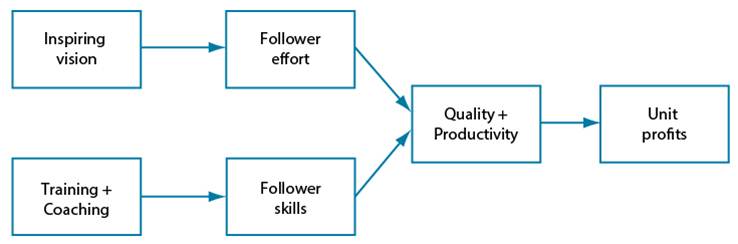
Leader effectiveness is occasionally measured in terms of the leader’s contribution to the quality of group processes, as perceived by followers or by outside observers. Does the leader enhance group cohesiveness, member cooperation, member commitment, and member confidence that the group can achieve its objectives? Does the leader enhance problem-solving and decision making by the group, and help to resolve disagreements and conflicts in a constructive way? Does the leader contribute to the efficiency of role specialization, the organization of activities, the accumulation of resources, and the readiness of the group to deal with change and crises?
What Criteria to Use?
There is no simple answer to the question of how to evaluate leadership effectiveness. The selection of appropriate criteria depends on the objectives and values of the person making the evaluation, and people have different values. For example, top management may prefer different criteria than other employees, customers, or shareholders. To cope with the problems of incompatible criteria, delayed effects, and the preferences of different stakeholders, it is usually best to include a variety of criteria in research on leadership effectiveness and to examine the impact of the leader on each criterion over an extended period of time. Multiple conceptions of effectiveness, like multiple conceptions of leadership, serve to broaden our perspective and enlarge the scope of inquiry.
-------------------------------------------------------------------------
You are the CEO of a medium-size company that makes window coverings. Your company has a real cost advantage in terms of being able to make custom window coverings at costs that are relatively low in the industry. However, the performance of your company has been lackluster. To make needed changes and improve performance, you met with the eight other top managers in your company and charged them with identifying problems and missed opportunities in each of their areas and coming up with an action plan to address the problems and take advantage of opportunities. Once you gave the managers the okay, they were charged with implementing their action plans in a timely fashion and monitoring the effects of their initiatives monthly for the next 8 to 12 months. You approved each of the managers’ action plans, and a year later most of the managers were reporting that their initiatives had been successful in addressing the problems and opportunities they had identified a year ago. However, overall company performance continues to be lackluster and shows no signs of improvement. You are confused and starting to question your leadership capabilities and approach to change. What are you going to do to improve the performance and effectiveness of your company?
|

No comments:
Post a Comment
Note: Only a member of this blog may post a comment.